Two of the Largest Banks in the United States and Their Presence in Utah.
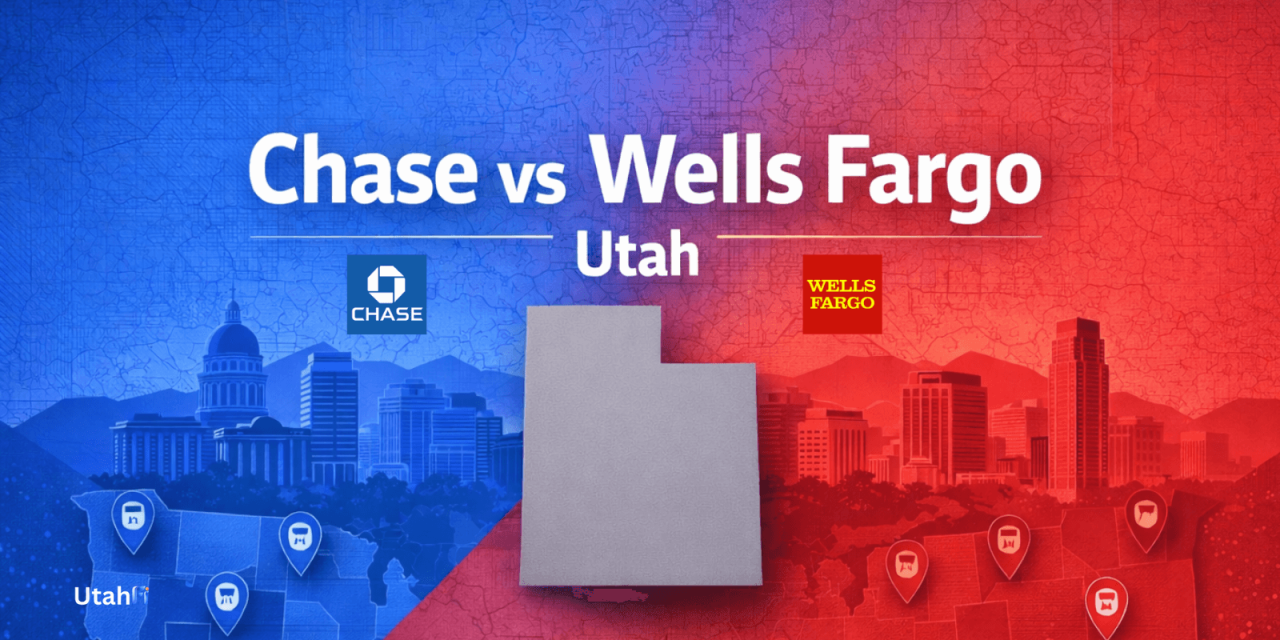
Chase and Wells Fargo are among the largest U.S. retail banks, with two of the biggest branch networks nationwide. Chase vs Wells Fargo is a common decision for Utah households because both offer full-service banking, large ATM networks, and nationwide access—so the real difference usually comes down to the details that affect you every week.
This UtahFi comparison is built to be neutral and easy to scan. In Chase vs Wells Fargo, we focus on everyday checking, how to avoid monthly fees, overdraft costs, branch and ATM convenience in Utah, and the mobile banking experience you’ll rely on for alerts, deposits, and payments, then close with a simple decision rule to help you pick the better fit.
Read the full profiles: Chase Bank profile • Wells Fargo profile
Chase vs Wells Fargo Snapshot: History, Size, and Branches
|
Snapshot |
Chase Bank |
Wells Fargo |
|---|---|---|
|
History |
Roots trace back to 1799 to Bank of Manhattan |
1854 as Wells Fargo & Co. |
|
Entry in Utah |
2008 with Washington Mutual acquisition |
1865, left in 1905, then returned in 1996 |
|
Branches (Utah) |
44 in Utah |
71 in Utah |
|
Deposits (Utah) |
$24,299,535,000 |
$12,759,807,000 |
|
Total assets (U.S.) |
$4.0 trillion |
$1.9 trillion |
|
Branches (U.S.) |
5,116 |
4,174 |
|
States |
48 states + DC |
40 states |
|
Website |
||
|
UtahFi Profile |
 |
|

Quick takeaway: If your priority is a larger nationwide branch footprint and a bigger ATM network, Chase usually edges it. If you want a comparable big-bank experience with strong branch coverage in Utah and a long-standing retail presence, Wells Fargo is a better fit.
Products & Services
At a high level, Chase vs Wells Fargo is not about whether basic banking products exist—both cover the essentials for most Utah households. The more useful difference is how each bank structures access, fees, and account experience across product lines.
For this Chase vs Wells Fargo comparison, the table below summarizes the main product categories you’re most likely to use.
|
Product Line |
Chase Bank |
Wells Fargo |
|---|---|---|
|
Personal banking |
Checking, savings, CDs |
Checking, savings, CDs |
|
Credit cards |
Cash-back and travel rewards cards |
Cash-back and rewards cards |
|
Home lending |
Mortgages, refinancing, home equity options |
Mortgages, refinancing, home equity options |
|
Personal Loans |
Not offered as a traditional unsecured personal loan; installment options may be available through eligible credit cards |
Offered; customer eligibility may apply |
|
Auto lending |
Auto loans through dealer relationships and select channels |
Auto loans and refinancing options |
|
Small business |
Business checking, credit cards, payments/merchant services, lending options |
Business checking, credit cards, payments/merchant services, lending options |
|
Investing / wealth |
Self-directed and advisory options through J.P. Morgan / Chase |
Self-directed and advisory options through Wells Fargo advisors/platforms |
Chase vs Wells Fargo Checking Accounts (main everyday checking):
- Monthly fee
- How to avoid the fee
- Minimum balance
- ATM access
- Overdraft fees
|
Snapshot |
Chase Total Checking |
Wells Fargo Everyday Checking |
|---|---|---|
|
Monthly Fee |
$15 |
$15 |
|
How to Avoid Fee |
$500+ qualifying electronic deposits, or $1,500+ daily balance, or $5,000+ average balance across eligible linked deposits/investments |
$500+ qualifying electronic deposits, or $1,500 minimum daily balance, or $5,000+ in qualifying deposit and investment balances. |
|
Minimum Balance |
$1,500 |
$1,500 |
|
ATM Access |
15,000+ ATMs, 5,000+ branches (national footprint) |
11,000+ ATMs, 4,100+ branches (national footprint) |
|
Overdraft Fees |
$34 per item, up to 3 times per day. |
$35 per item, up to 3 times per day. |
|
Best for |
People who want nationwide branch/ATM convenience and a clear fee-waiver path using direct deposit or balances. |
People who want strong retail branch coverage in many Utah areas and a clear fee-waiver path using direct deposit. |
Credit cards: Main Rewards Card
For a clean, mainstream comparison, UtahFi uses 2 popular no-annual-fee cards that represent each bank’s everyday rewards style. Chase vs Wells Fargo here is Chase Freedom Unlimited vs Wells Fargo Active Cash.
|
Rewards Card |
Chase Freedom Unlimited |
Wells Fargo Active Cash |
|---|---|---|
|
Annual fee |
$0 |
$0 |
|
Rewards earning (baseline) |
1.5% cash back on most purchases |
2% cash rewards on purchases |
|
Cash-back alternative |
Chase Freedom Flex |
Wells Fargo Autograph® Card |
|
Foreign transaction fee |
3% |
3% |
|
Late payment fee |
$29 for the first violation, or up to $40 if another late payment occurs within the next six billing cycles |
Up to $40 |
|
Best For: |
People who want a simple everyday card and may also want to pair rewards with a broader Chase ecosystem later. |
People who want straightforward, flat-rate cash rewards on most purchases and prefer to keep it simple. |
UtahFi note: In Chase vs Wells Fargo, rewards cards can look very similar on paper. The differences that matter most usually show up in how easy it is to redeem rewards, how the late-fee structure works, and whether the card fits naturally with your day-to-day banking and account setup.
Digital Banking & Technology
Chase vs Wells Fargo often comes down to which mobile experience feels clearer for your day-to-day banking in Utah, especially for card controls and alerts.
|
Digital Banking |
Chase Bank |
Wells Fargo |
|---|---|---|
|
Overall feel |
Feature-dense “ecosystem” experience across checking, cards, and more |
Banking-first experience that stays focused on everyday tasks |
|
Card controls |
Strong self-serve controls for cards and spending settings |
Strong self-serve controls for cards and spending settings |
|
Alerts & visibility |
Detailed alerts and account activity visibility |
Detailed alerts and account activity visibility |
|
Best for |
People who want a single app experience across multiple Chase products |
People who want a single app experience across multiple Chase products |
UtahFi note: In Chase vs Wells Fargo, digital differences are often subtle until you’re using the app weekly. Pay attention to alert timing, how fast card lock/unlock updates, and how easy it is to find overdraft settings, transfer options, and deposit status.
App Store / Google Play ratings
In Chase vs Wells Fargo, ratings can be a useful quick signal, but recent reviews matter more than the headline number.
|
App Ratings |
Chase Bank |
Wells Fargo |
|---|---|---|
|
Apple App Store rating |
||
|
Google Play rating |
||
|
What to watch in reviews |
Reported issues after updates, especially around payments and “pending” behavior |
Reported issues with deposit/photo capture, app speed, and how quickly balances/transactions reflect |
Community Presence & Brand Perception
Chase vs Wells Fargo can feel different in Utah depending on where you see each brand show up locally—community partnerships, business programs, and the organizations they support.
|
Community Presence |
Chase Bank |
Wells Fargo |
|---|---|---|
|
Primary Utah focus |
Small business growth, housing initiatives, and economic development |
Community development, food security, and financial education |
|
Utah-specific example |
Utah Export Acceleration Grant support through World Trade Center Utah |
Utah Food Bank partnership supporting Mobile School Pantries in San Juan County |
|
Financial education |
Hosts local financial health workshops (example: University of Utah) |
Hands on Banking program provides free financial education resources |
|
Who it resonates with |
People who want a national bank that also invests in local business and housing efforts |
People who want a national bank with visible philanthropy and community programs |
Account Opening Requirements
When people compare Chase vs Wells Fargo, account opening is usually straightforward, but the experience can differ depending on whether you’re opening online, opening in a branch, or opening as a non-citizen. For Chase vs Wells Fargo in Utah, bringing the right documents is the main factor that prevents delays.
|
Requirements |
Chase Bank |
Wells Fargo |
|---|---|---|
|
Geographic eligibility |
Available to Utah residents; online and in-branch account opening |
Available to Utah residents; online and in-branch account opening |
|
Minimum age |
18 |
18 |
|
ID required |
Primary + secondary ID accepted (varies by customer type) |
2 forms of ID (primary + secondary) |
|
SSN / ITIN |
SSN or ITIN required for identity verification |
SSN or ITIN required for identity verification |
|
Non-citizens |
Non-citizens can open accounts with acceptable ID (passport or other), plus additional documentation may apply |
Non-citizens can open accounts with SSN or ITIN and 2 forms of ID; additional requirements apply if no U.S. taxpayer ID |
|
U.S. address |
U.S. address required |
U.S. address required |
|
Opening deposit |
$25 |
$25 |
|
Joint accounts |
Available |
Available |
UtahFi note: For non-citizens, the smoothest path is usually opening in a branch with 2 forms of ID and proof of U.S. address, especially if you do not have an SSN. Online applications can be more limited depending on the exact account and your documentation.
Chase vs Wells Fargo: Which One Is Right for You?
Choose Chase Bank if you:
- Want a larger nationwide branch footprint and a very large ATM network.
- Prefer keeping banking simple with a mainstream checking account and broad national access.
- Expect to travel, relocate, or bank across state lines and want consistent access.
Choose Wells Fargo if you:
- Want a comparable big-bank experience with strong branch coverage in Utah.
- Prefer a familiar retail banking setup and plan to use branches for routine services.
- Want a simple path to everyday cash rewards with a flat-rate card option.
Verdict From UtahFi
There isn’t a universal winner. Chase vs Wells Fargo is a comparison between 2 large U.S. retail banks that can both work well in Utah, depending on your priorities.
If you want a simple decision rule:
- Pick Chase if nationwide footprint and ATM access are your top priorities.
- Pick Wells Fargo if Utah branch convenience and in-person services matter more.