MX Technologies: Overview
 MX Technologies, Inc. (MX) is a Utah-based fintech company focused on financial data connectivity, verification, data enhancement, and digital money experiences. Instead of operating like a traditional bank or credit union, MX provides technology that helps financial institutions, fintechs, and other businesses connect to financial data shared with the customer’s permission and use that data more effectively. MX has its headquarters in Lehi, Utah.
Website: www.mx.com
In Simple Terms
MX helps banks, credit unions, and fintech apps connect to financial data and use it better. It works behind the scenes to support things like account connections, balance checks, and money tools.
Background and Growth
MX Technologies was founded in 2010 and grew into one of Utah’s best-known fintech companies. Ryan Caldwell founded the company, and Brandon Dewitt became part of MX early on when the company acquired MyJibe in 2011. That acquisition became an important part of MX’s early growth and helped shape the company’s direction in digital finance. MX is based in Lehi, Utah, and over time it expanded from a Utah startup into a much more visible fintech brand.
MX also grew through later expansion and acquisitions. In 2020, MX acquired FileThis, a documentation aggregation company, which broadened its connections beyond basic account data into documents such as statements, bills, paystubs, and tax forms. By 2021, MX reported that it powered more than 2,000 banks, credit unions, fintechs, and technology companies, with reach across more than 200 million consumers.
The founders also brought different backgrounds to MX’s early development. Before starting MX, Ryan Caldwell had already built and exited several technology startups and had consulting experience with companies such as Visa and Microsoft. Brandon Dewitt came from the personal financial management side as the co-founder and CTO of MyJibe, which later became part of MX. Brandon Dewitt passed away in 2021 at age 38.
What MX Does
MX helps financial institutions, fintechs, and other businesses connect, verify, enhance, and use financial data. In practical terms, that means MX provides technology that pulls financial information together, confirms account details, improves data quality, and supports better digital tools and experiences.
MX is connected to areas such as financial data aggregation, account verification, transaction data enhancement, personal financial management, and digital banking tools, which help power budgeting tools, account connections, and other digital experiences inside financial apps.
For a deeper explanation, see Financial Data Aggregation: The Rise of Connected Financial Data.
MX is also relevant to trends such as embedded finance, where financial tools and services are built into apps and platforms rather than offered only through traditional banks. For a deeper explanation, see Embedded Finance: How Financial Services Move Into Apps.
What makes MX different is that it is not mainly a consumer-facing financial brand. Most people will not open an account directly with MX the way they would with a bank or credit union. Instead, MX works behind the scenes, helping other companies build and improve their own financial products.
These capabilities also connect to AI in finance, where financial data is used to generate insights, automate decisions, and improve digital financial experiences. For a deeper explanation, see AI in Finance: How Artificial Intelligence Is Changing Money.
Open Finance
MX Technologies is closely linked to open finance, which is one of the main ideas behind the company’s platform and positioning. In simple terms, open finance refers to the secure sharing and use of financial data across different companies and services with the customer’s permission. That can help create better digital tools, smoother account connections, and more personalized financial experiences.
That matters because MX operates in the part of fintech that helps financial institutions and apps connect to data more securely and use that data in more useful ways. In other words, MX is part of the technology layer behind many of the account connections, financial dashboards, and digital money tools people use today.
Main Products and Services
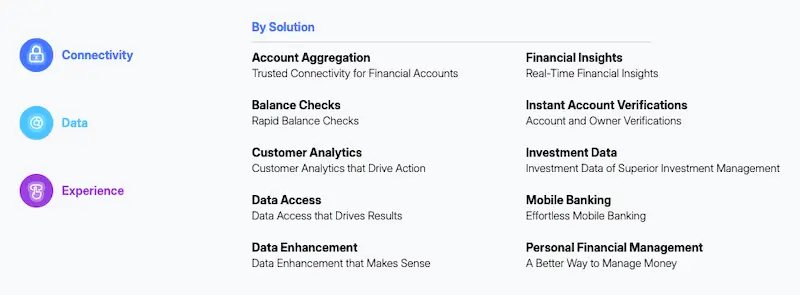
mx.com | Products
MX’s main products and services include:
- Account Aggregation — helps bring financial accounts together in one place so users and financial companies can view connected account information more easily.
- Balance Checks — helps confirm account balances during financial activities and workflows.
- Customer Analytics — helps financial companies better understand customer behavior and use that information to improve decisions and services.
- Data Access — helps financial companies securely access and use financial data.
- Data Enhancement — helps clean up, label, organize, and add context to financial data so it is easier to understand.
- Financial Insights — helps turn financial data into useful insights that can support better money tools and experiences.
- Instant Account Verifications — helps verify account ownership and account details more quickly.
- Investment Data — provides investment-related data for financial tools and platforms.
- Mobile Banking — supports mobile banking experiences inside financial apps.
- Personal Financial Management — supports budgeting, spending views, and other money management tools.
These products sit under MX’s broader areas of Connectivity, Data, and Experience. Together, they show that MX focuses on helping financial institutions and fintechs connect accounts, verify information, improve financial data, and create better digital money tools and experiences.
Financial Institutions Using MX
One reason MX Technologies stands out in Utah’s fintech landscape is that its technology has been used by well-known organizations in the state. MX has worked with America First Credit Union and Utah Community Credit Union, which gives the company a direct connection to recognizable financial institutions in Utah. MX has also partnered with LoanPro and Lendio, two Utah fintech companies. MX worked closely with Lendio in launching MXdata for Business, and Lendio used that product to help bookkeeping customers visualize spending habits in real time.
MX’s reach also goes beyond Utah-based companies. U.S. Bank is another example of a major financial institution that has worked with MX. That mix of Utah ties and broader industry reach helps explain why MX is one of the more important fintech companies based in Utah.
Competitors
MX operates in a competitive part of fintech that includes other companies focused on financial data connectivity and open finance. Two of the best-known competitors are Plaid and Finicity (acquired by MasterCard).
Both are relevant in Utah because Plaid has had a Salt Lake City presence, while Mastercard Finicity has longstanding Utah roots. At the time Mastercard acquired Finicity in 2020, Finicity was based in Murray, Utah. That makes the competitive landscape more interesting in Utah, since MX is not the only financial data company with ties to the state.

Platform, Access, and Business Model
MX is primarily a B2B fintech company, which means it mainly works with financial institutions, fintechs, and other businesses rather than everyday consumers looking to open an account directly with MX. In practice, that means most people interact with MX through another company’s app, platform, or digital banking experience instead of using MX as a stand-alone consumer brand.
That business model makes MX different from a more customer-facing fintech such as Bluevine. A company like Bluevine offers financial products directly to businesses, while MX works more like a technology provider behind the scenes, helping other financial companies build better digital tools, account connections, and data-driven experiences.
Limitations
MX Technologies is not the easiest fintech to evaluate from a typical consumer angle because it is not primarily a direct-to-consumer financial brand. Someone looking for a checking account, business account, or loan would not usually compare MX the same way they would compare a bank, credit union, or customer-facing fintech.
That does not make MX less important. It simply means its value is easier to understand through the technology it provides to other companies rather than through financial products offered directly to the public.
Conclusion
MX Technologies is one of Utah’s most important fintech companies because it helps power the flow of financial data behind many modern financial tools and experiences. Based in Lehi, Utah, the company focuses on connectivity, data, experience, and open finance for financial institutions, fintechs, and other businesses.
Its connections to organizations such as America First Credit Union, Utah Community Credit Union, LoanPro, Lendio, and U.S. Bank help show both its Utah roots and its broader reach. That makes MX a strong example of how Utah contributes not only to banking and credit unions, but also to the technology shaping the future of finance.

Disclaimer:
This page is not affiliated with, maintained by, or sponsored by MX Technologies. The information provided in this overview may be outdated or inaccurate after the publication date. UtahFi does not assume responsibility for the accuracy of the content. The logo is a registered trademark of MX Technologies, Inc.