
What is AI in Finance
Artificial intelligence in finance refers to the use of systems that can analyze data, detect patterns, and make decisions related to money and financial services.
In recent years, this has evolved into what can be described as “AiFi” (AI-driven finance) — a shift where artificial intelligence is no longer just a feature, but increasingly acts as the core operating layer behind lending, payments, fraud detection, and financial decision-making.
Instead of relying on human judgment and fixed rules, financial systems now use models that adapt, learn, and improve over time, enabling faster, more accurate, and more scalable outcomes.
In Simple Terms
AI in finance is like an autopilot for financial decisions.
It analyzes data in the background and makes fast decisions on things like approvals, fraud detection, and recommendations without needing manual review.
The more data it sees, the better those decisions become.
What Changed (Before vs Now)
Before AI became common in financial services, most decisions were manual, slow, and rule-based.
Financial institutions relied on:
- Human review for approvals and risk decisions
- Checklists and fixed rules to guide decisions
- Limited data, mostly credit history and basic account activity
- Delayed processing, often taking hours or days
A payment, loan, or alert would often depend on someone reviewing information later, rather than being handled instantly.
Now, financial systems are increasingly AI-driven and automated.
Today, systems can:
- Analyze large amounts of data instantly
- Detect fraud in real time as transactions happen
- Make credit decisions dynamically, using broader data like behavior and cash flow
- Provide immediate recommendations based on patterns and activity
Instead of reacting after something happens, AI systems can predict, decide, and respond instantly.
This shift moves financial services from manual and reactive to automated, real-time, and predictive decision-making.

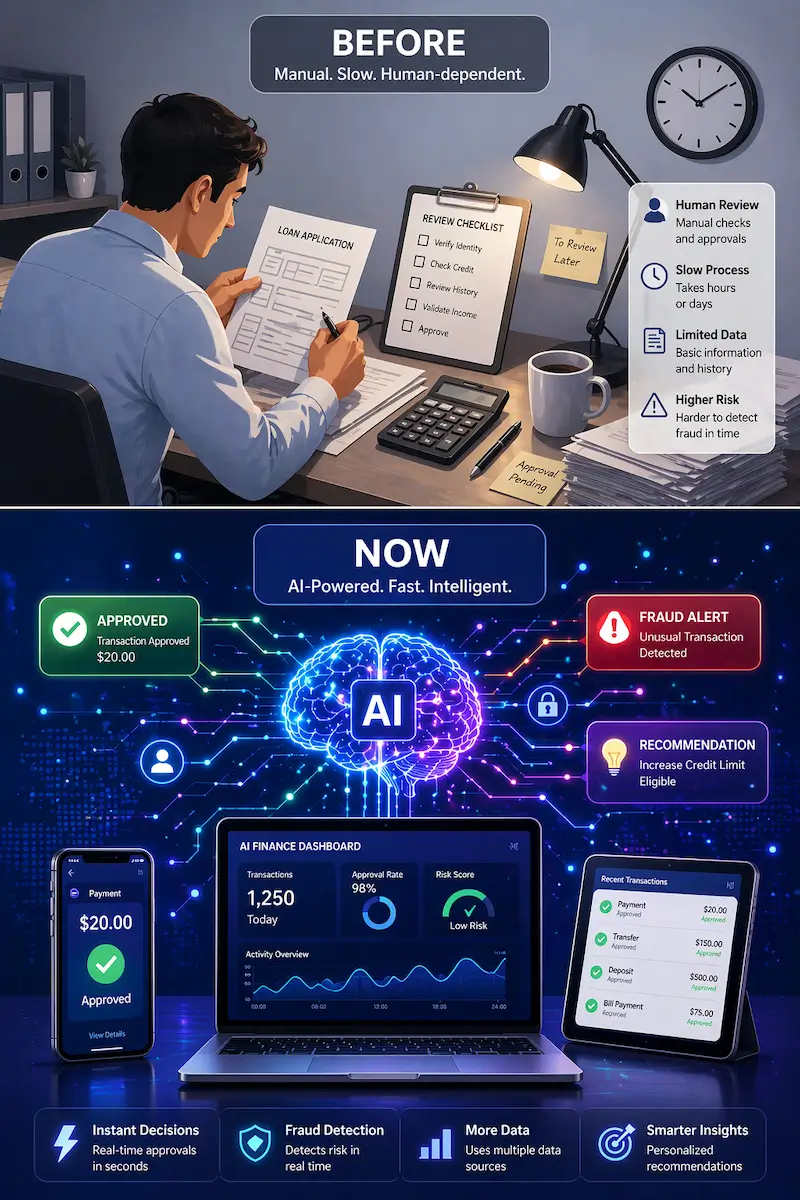
Before vs Now: AI in Finance
Examples of AI in Finance
AI is now embedded across many parts of financial services:
- Fraud detection — AI can spot unusual transactions in real time, helping financial institutions block suspicious activity before more damage is done.
- Credit decisions — AI models evaluate risk faster by looking beyond traditional credit scores and incorporating signals such as cash flow, account activity, and behavior patterns, as used in small business loan marketplaces.
- Personalized insights — financial apps analyze spending habits, highlight trends, and suggest actions that better match a user’s financial behavior and goals.
- Chatbots and support — AI-powered assistants answer questions, guide users through tasks, and make customer support faster and more available.
These examples show how AI is applied across financial services. In business environments, similar automation can be used to process invoices, route approvals, and execute payments, as seen in Accounts Payable Automation: The Shift to Automated Payments.
How AI in Finance Works
At a high level, AI in finance works by turning financial data into decisions.
It starts with data inputs such as transactions, account activity, income signals, spending behavior, and other financial patterns. This data is often combined into a single view across accounts, as explained in Financial Data Aggregation: The Rise of Connected Financial Data.
Some of these inputs can also come from payroll systems, where apps access verified income and employment data through payroll connections, as explored in Payroll Connectivity: The New Way Apps Access Income Data.
That information is then processed through models and algorithms designed to identify patterns, detect risk, and predict likely outcomes.
Over time, these systems improve through continuous learning. As they process more data and outcomes, they become better at spotting fraud, evaluating risk, and generating more accurate recommendations.
These types of AI-driven insights are often surfaced through tools like those described in Business Credit Platforms: How Businesses Track Their Credit.
This creates a cycle where financial systems become faster, smarter, and more efficient as they operate.
Key Players and Competitors
Some Utah-based companies help illustrate how AI is being applied across financial services:
- MX Technologies — supports financial data insights, personalization, and transaction intelligence
- Nav — uses data to improve credit visibility and decision-making for small businesses
- HealthEquity — applies automation to healthcare-related financial accounts and benefits management
Outside Utah, several global companies are also shaping AI in finance:
- FICO — a major player in credit decisioning and predictive analytics
- Stripe — uses AI for payments optimization and fraud detection
- PayPal — applies AI to transaction monitoring and risk scoring
- Plaid — enables data connectivity that powers AI-driven insights
These companies operate at different layers, but together they reflect the broader shift toward AI-driven financial systems.

Why It Matters
The move toward AI-driven finance is changing how financial services work:
- Faster decisions — processes that once took days can now happen in seconds.
- Reduced fraud — real-time monitoring helps detect and prevent suspicious activity earlier.
- Better personalization — financial tools can adapt to individual behavior and needs, enhancing digital-first banking experiences delivered through apps and online platforms. For a deeper explanation, see Digital-First Banking: How Online Platforms Are Changing.
- More efficient systems — automation reduces costs and allows services to scale more easily.
These improvements are making financial services more responsive, more accessible, and more data-driven.
AI in Finance and Open Finance
AI depends on data, and that is where Open Finance plays a critical role.
Open Finance allows financial data to be shared securely across platforms, giving AI systems more information to work with. This leads to:
- More accurate insights
- Better recommendations
- Stronger decision-making
Open Finance provides the data layer, while AI provides the decision layer.
To see how this works in more detail, read Open Finance: How Financial Data Becomes Shareable and Portable.
AI in Finance and Embedded Finance
AI also connects closely with Embedded Finance, which defines where financial services take place.
Embedded Finance integrates financial services directly into apps and platforms, while AI makes those services smarter and more adaptive.
For example:
- A payment inside an app is embedded finance
- The system approving or flagging that payment is powered by AI
Together, they create financial experiences that are seamless on the surface and intelligent behind the scenes.
To understand how financial services are built directly into apps and platforms, read Embedded Finance: How Financial Services Are Moving Inside Apps.

Limitations
Despite its advantages, AI in finance has limitations:
- Data quality issues — incomplete or inaccurate data can affect outcomes.
- Bias in algorithms — models can reflect historical biases and produce uneven results.
- Lack of transparency — some AI-driven decisions are difficult to explain clearly.
- AI hallucinations and reliability risks — AI systems can generate incorrect, misleading, or fabricated outputs, which can affect financial advice, reporting, and decision-making.
- Dependence on oversight and data availability — AI systems still rely on strong data inputs, human review, and clear controls to be used responsibly.
These challenges highlight the need for careful design, human oversight, and responsible use of AI in financial systems.
What’s Next (Future of AI in Finance)
AI in finance is continuing to evolve:
- AI assistants — systems that help users manage money and make decisions.
- Automated approvals — faster and more dynamic lending and payment decisions.
- Predictive planning — systems that anticipate financial needs before they happen.
- Deeper integration across platforms — AI connecting financial services across multiple apps and systems, often delivered through models like banking as a service
Recent developments also show that AI companies themselves are moving into financial services. For example, OpenAI, the company behind ChatGPT, has acquired personal finance fintech Hiro, an AI-powered app designed to act as a “personal CFO,” helping users manage spending, savings, and financial decisions using data and automation.
This suggests that finance may not only be shaped by banks and fintech companies using AI, but also by AI-native platforms building financial capabilities directly.
The direction is toward systems that are not just reactive, but predictive and proactive.
Conclusion
AI in finance represents a shift from manual, rule-based systems to automated, data-driven decision-making.
Through the lens of AiFi, this transformation shows how artificial intelligence is becoming the core layer behind modern financial services.
By improving speed, accuracy, and personalization, AI is helping reshape how financial systems operate — making them faster, smarter, and more adaptive.
This shift is also visible in Utah through companies working in financial data, business finance, and benefits-related technology, connecting global AI trends to the local fintech ecosystem.

Disclaimer: Information in this article is for educational purposes and may change over time.