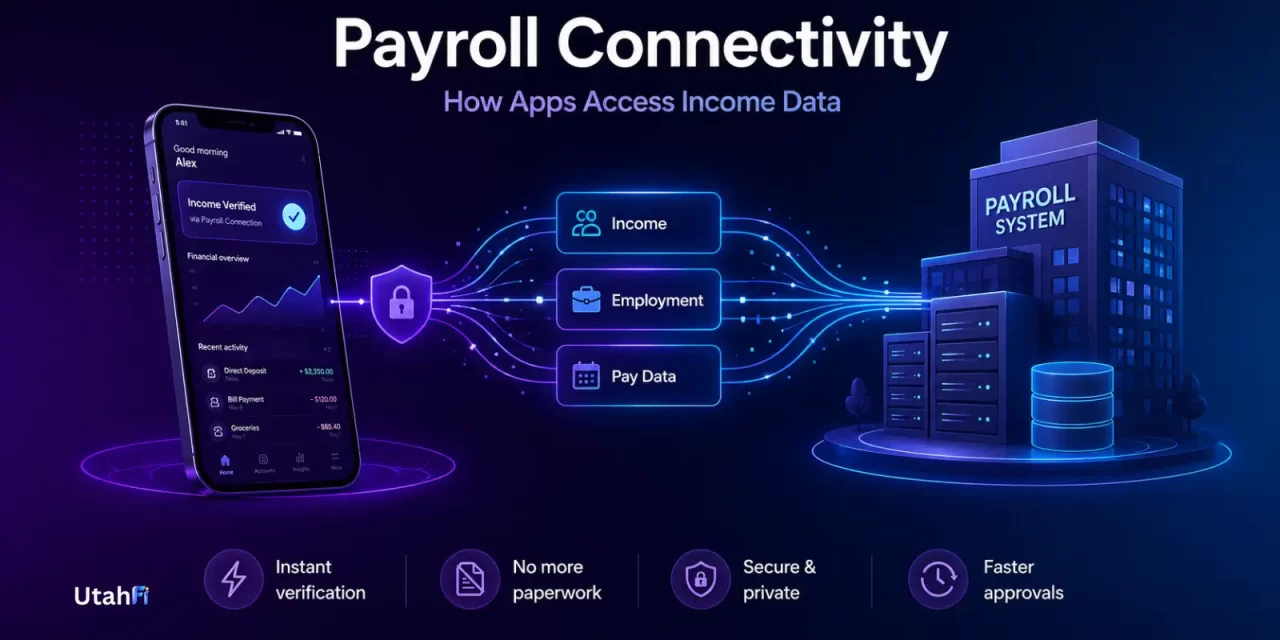
What Is Payroll Connectivity
Payroll connectivity allows apps to connect directly to payroll systems to access income and employment data in real time. Instead of relying on documents like pay stubs, platforms can retrieve verified information instantly with user permission.
This includes details such as income, employment status, and pay frequency, which can be used to support financial services like lending, onboarding, and account setup.
This represents a shift toward direct data access, where systems communicate with each other instead of relying on manual inputs or outdated documents.
In Simple Terms
Think of payroll connectivity like logging into your bank account through an app instead of uploading screenshots of your balance.
Instead of sending documents to prove your income, you simply connect your payroll account, and the app verifies everything automatically. What used to take days can now happen in seconds.

What Changed (Before vs Now)
Before payroll connectivity, income verification was a manual and time-consuming process that relied on documents, employer checks, and back-and-forth communication.
Applicants had to upload pay stubs, provide employer details, or wait for verification, which created delays, errors, and friction.
Now, payroll connectivity replaces those steps with direct system connections. Data is pulled instantly from payroll providers, reducing paperwork and making the process faster, more accurate, and more reliable.
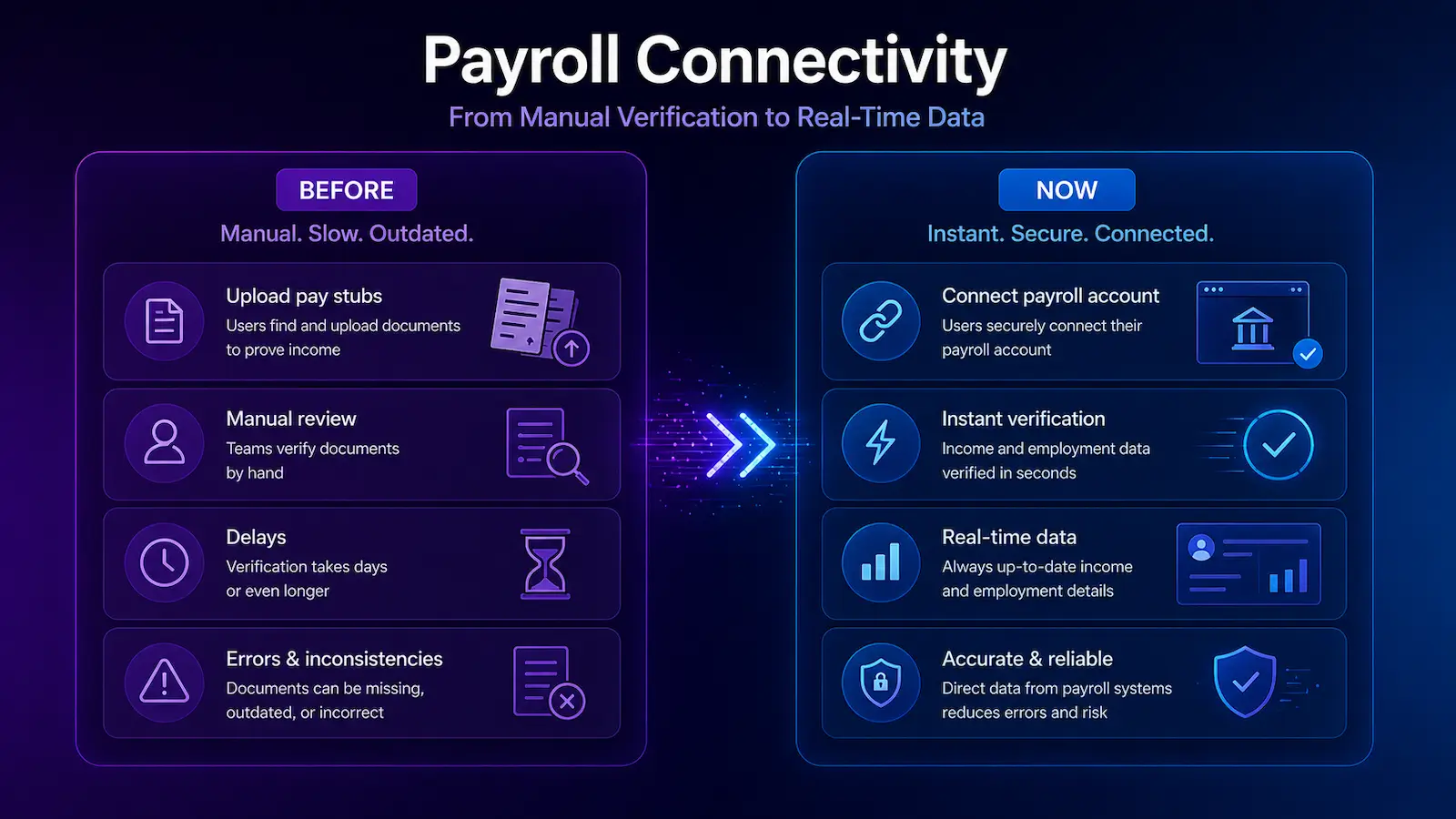
Payroll Connectivity: Before vs Now
Examples of Payroll Connectivity
Payroll connectivity is already being used across multiple financial use cases.
- Loan applications that verify income instantly without documents
- Direct deposit switching that allows users to update payroll details in minutes
- Faster onboarding for financial accounts and services
- Apps accessing employment data to personalize financial tools
- Income verification for rentals or subscriptions
These use cases show how payroll data is becoming part of the digital financial experience, rather than something handled manually behind the scenes.
How Payroll Connectivity Works
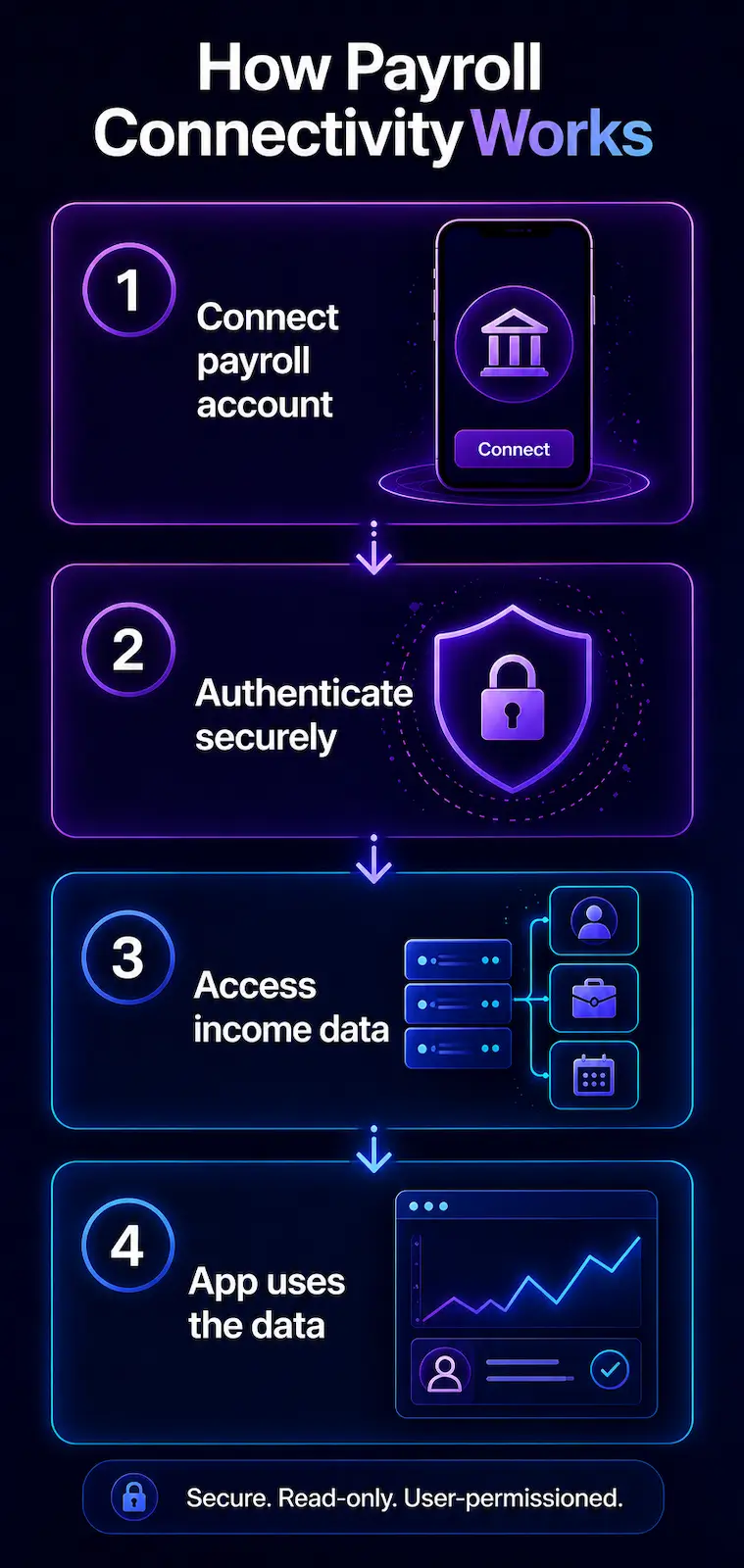
Payroll connectivity can be understood as a simple four-step process that allows apps to securely access income and employment data. Many of these connections rely on major payroll providers such as ADP, which handle payroll processing for millions of employees.
First, the user connects their payroll account by selecting their employer or payroll provider inside the app. Next, the user authenticates securely and grants permission, confirming that the app can access their payroll data.
Once connected, the system accesses income and employment data such as salary, pay history, and job status in real time. Finally, the app uses that data to verify income, speed up onboarding, or power financial features in the background.
Throughout this process, encrypted connections and permission-based access ensure that data is shared securely and only with the user’s approval.
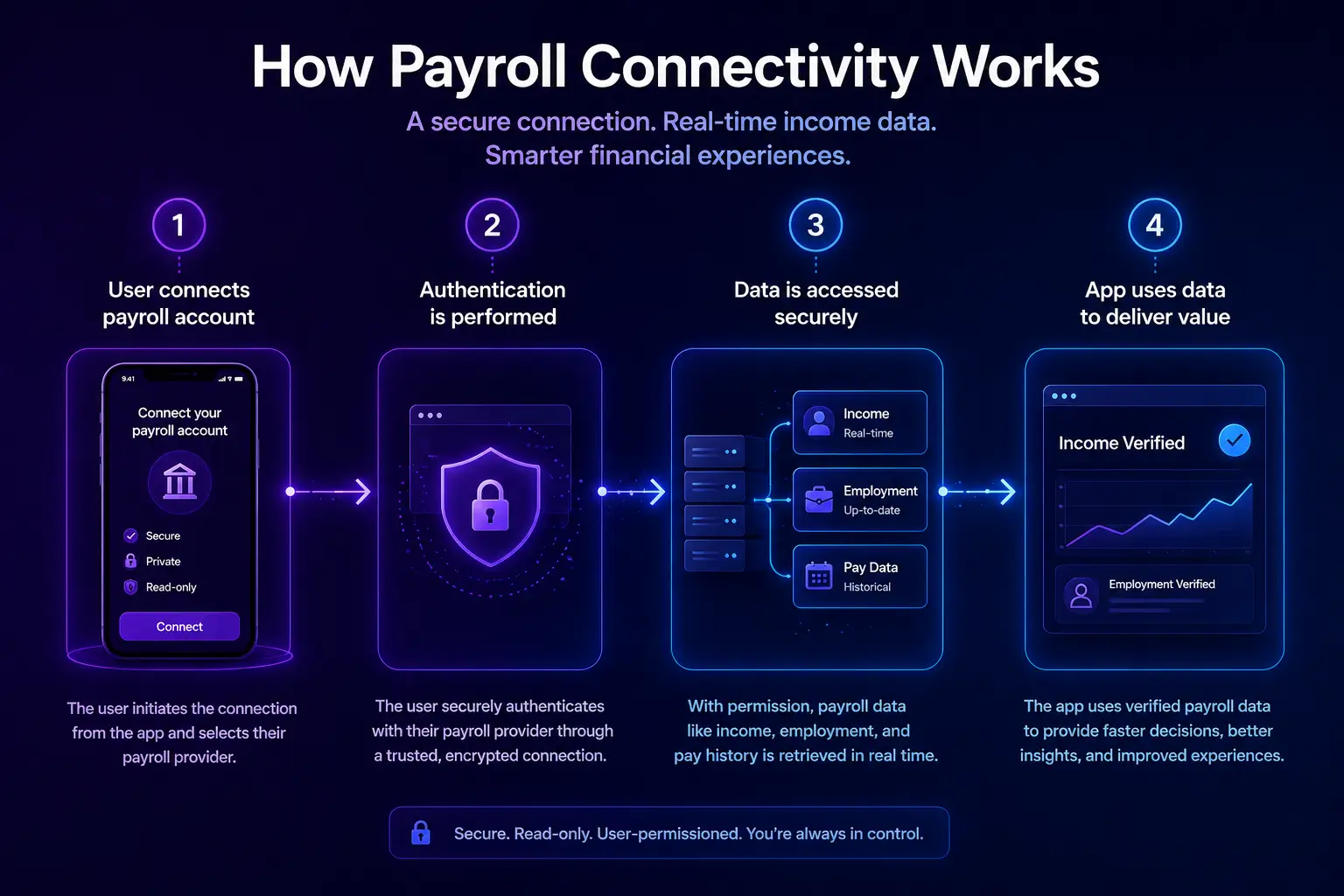
How Payroll Connectivity Works
Key Players and Competitors
Several companies provide payroll connectivity infrastructure, though the category remains relatively specialized.
Utah-based example:
- Atomic: A platform focused on connecting payroll data for income verification, employment data access, and direct deposit switching
Competitors:
- Argyle: Provides access to employment and income data across payroll systems
- Pinwheel: Focuses on income verification and direct deposit switching for financial apps
These companies operate behind the scenes, enabling apps to integrate payroll data into their services.
Why It Matters
Payroll connectivity improves financial services in several key ways.
- Faster approvals by eliminating manual verification
- Reduced paperwork for users and institutions
- Improved accuracy through direct data access
- Better user experience with fewer steps and delays
These benefits make financial services more efficient, accessible, and scalable.

Payroll Connectivity and Open Finance
Payroll connectivity expands data sharing beyond traditional banking by adding income and employment data to the financial ecosystem.
While bank connections focus on balances and transactions, payroll connectivity adds a new layer of verified income and job data, giving financial apps a more complete view of a user’s financial situation. This makes services like lending, budgeting, and onboarding more accurate and efficient.
This shift is part of a broader movement toward open data systems, where users can securely share financial information across platforms.
To understand how this broader model works, see Open Finance: How Financial Data Becomes Shareable & Portable.
Payroll Connectivity and AI in Finance
Payroll connectivity provides structured, verified income and employment data that can improve how financial systems make decisions.
Instead of relying on self-reported information or uploaded documents, systems can use real payroll data to assess risk, verify income, and personalize financial products more accurately. This can lead to faster approvals and more consistent outcomes.
This type of data-driven decision-making is part of a broader shift toward intelligent systems in finance.
To see how these systems operate at a larger scale, explore AI in Finance: How Artificial Intelligence Is Changing Money and Financial Services.
Payroll Connectivity and Embedded Finance
Payroll connectivity helps bring financial services directly into apps by using income and employment data behind the scenes.
Instead of asking users to upload documents or go through separate verification steps, apps can use payroll data to automatically verify income, enable features, and streamline onboarding within the same experience. This makes financial tools feel faster and more integrated.
As a result, services like lending, savings tools, and payments can be delivered seamlessly inside platforms, without requiring users to leave the app.
To explore how financial services are built into everyday platforms, see Embedded Finance: How Financial Services Move Into Apps.
Limitations
Despite its benefits, payroll connectivity still has limitations.
- Not all employers or payroll systems are supported
- Privacy and security concerns require strong user trust
- Dependence on integrations can create gaps in coverage
- Data inconsistencies may occur across systems
These challenges show that the system is still evolving and not yet fully universal.

What’s Next (Future of Payroll Connectivity)
Payroll connectivity is expected to expand as coverage improves and more financial services rely on real-time data.
As more employers and payroll providers become connected, access to income and employment data will become more consistent and widely available. This will reduce gaps and make the system more reliable across different users.
At the same time, payroll data may evolve from periodic snapshots to real-time income tracking, allowing apps to respond more quickly to changes in earnings or employment.
Payroll connectivity is also likely to be integrated into a wider range of financial tools, supporting lending, savings, payments, and financial planning in more automated ways.
Over time, this could become a standard layer of financial infrastructure, similar to how bank account connections are used today.
Conclusion
Payroll connectivity represents a shift from manual income verification to real-time data access.
By connecting directly to payroll systems, apps can verify income, streamline onboarding, and improve financial decision-making. What once required documents and delays is now handled through secure, instant connections.
As adoption grows, payroll connectivity is becoming an important part of how modern financial services are delivered—making them faster, simpler, and more integrated into everyday digital experiences.

Disclaimer: Information in this article is for educational purposes and may change over time. UtahFi is not affiliated with, sponsored by, or endorsed by any company mentioned in this article, including Atomic. This content is intended to provide general information about financial technology and does not represent a partnership or official relationship.