Small Business Loan Marketplaces: The Shift From Single Lenders to Multi-Lender Platforms
Small business loan marketplaces are platforms that connect businesses with multiple lenders in one place, allowing them to compare financing options through a single application. Instead of applying to a single bank or lender, businesses can now submit one application and review multiple offers at once.
This model improves speed and visibility, giving businesses access to a wider range of loan options, terms, and approval criteria. It shifts the process from searching for lenders to comparing options more efficiently.
At the same time, not all small business loan marketplaces operate the same way. Some keep the experience centralized, while others may share information more broadly, which can affect how offers are delivered and how lenders interact with applicants.
In Simple Terms
A small business loan marketplace works like a comparison website for flights or hotels.
Instead of visiting multiple airline websites, you search once and see several options at once. In the same way, a business submits one loan application and receives multiple offers from different lenders, allowing for easier comparison and faster decision-making.

What Changed (Before vs Now)
In the past, businesses typically applied for loans one lender at a time. This meant filling out separate applications, waiting for responses, and often having limited visibility into other options.
This process could take days or weeks, and businesses often accepted the first approval they received without knowing if better options existed.
Now, small business loan marketplaces allow businesses to apply once and receive multiple offers, reducing repetitive work and improving transparency. This shift has made the process faster, more efficient, and more competitive, as lenders are effectively competing for the same borrower.
Instead of navigating a fragmented system, businesses now interact with a centralized platform that simplifies comparison and selection.
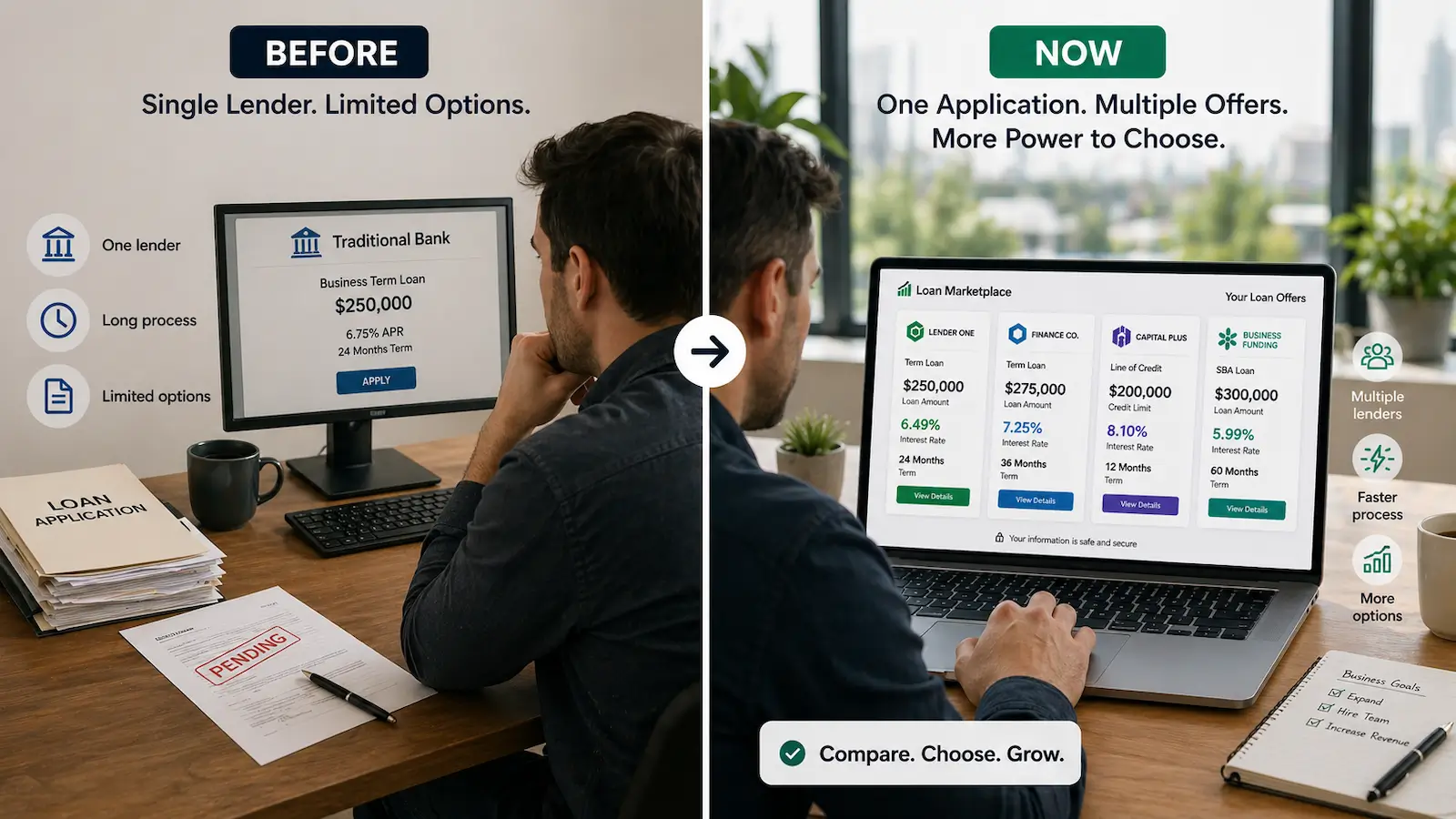

Small Business Lending Before vs Now
Examples of Loan Marketplaces
Loan marketplaces are used in several ways across the business lending ecosystem:
- Platforms that display multiple loan offers from different lenders, including term loans, lines of credit, and SBA loans
- Tools that help businesses compare rates, repayment terms, and funding timelines
- Systems that help businesses connect with multiple lenders through a single application
- Fully online applications replace in-branch visits and manual paperwork, reflecting the broader shift toward digital banking platforms. For a deeper explanation, see Digital-First Banking: How Online Platforms Are Changing
These platforms can support a wide range of businesses, from new startups seeking initial funding to established companies comparing financing options.
In many cases, marketplaces also provide filtering and matching tools, helping businesses focus on options that may fit their profile.
How Loan Marketplaces Work
The process follows a simple structure:
- A business submits one application through the platform
- The platform matches or routes the application to participating lenders
- Interested lenders review the application and may return financing offers
- The business compares available options and selects the best fit
This is where loan management systems take over after a loan is selected, handling payments and ongoing loan activity, as explained in Loan Management Systems Powering Modern Lending Platforms.
In many cases, this starts with pre-qualification, where lenders evaluate basic information to determine potential eligibility.
Businesses often review their credit profile before selecting an offer, using tools like those described in Business Credit Platforms: How Businesses Track Their Credit.
This approach allows businesses to move from initial comparison to final selection in a more structured and efficient way.

Key Players and Competitors
Several platforms operate as small business loan marketplaces, connecting businesses with multiple lenders or financing providers through a single application. These companies represent how the model works in practice across the small business lending ecosystem.
Utah-based companies
- Lendio — Headquartered in Lehi, Utah; matches businesses with financing across more than 10 loan types from more than 100 integrated lenders and has expanded its platform into embedded and AI-driven lending
Other small business loan marketplaces
- Fundera by NerdWallet — Small business financing marketplace that uses one application to help businesses compare multiple financing options
- LendingTree — Marketplace platform that connects borrowers with financing options across business and consumer financial products
- BusinessLoans.com — Platform where businesses submit one application to explore financing options from a network of providers
- Lendzi — Connects businesses with lending partners and provides access to multiple financing options through its application process
Why It Matters
Loan marketplaces improve how businesses access financing.
- More visibility: businesses can compare multiple loan options at once instead of relying on a single lender
- Faster process: one application replaces multiple submissions, reducing time and effort
- Better matching: access to different lenders increases the chances of finding a suitable option
- Expanded access: businesses that may not qualify traditionally can connect with alternative lenders
These advantages make business financing more accessible and easier to navigate.
For a broader view of small business financing programs and requirements, visit the U.S. Small Business Administration website.

Loan Marketplaces and Embedded Finance
Loan marketplaces are increasingly integrated into the platforms businesses already use, such as accounting software, payment systems, and e-commerce tools. This allows businesses to access financing without leaving their existing workflows.
Instead of searching for lenders separately, financing options can appear inside the same tools used to manage operations, making access more immediate and contextual.
This shift reflects the broader trend explained in Embedded Finance: How Financial Services Move Into Apps.
Loan Marketplaces and AI in Finance
Artificial intelligence is increasingly used to improve how loan marketplaces process applications and match businesses with lenders. By analyzing financial data and application information, AI-powered systems can help identify financing options that may fit a business’s profile.
AI can also support document analysis, risk assessment, and early-stage underwriting, helping platforms and lenders process applications more efficiently while reducing some manual work.
These developments are part of the broader shift explored in AI in Finance: How Artificial Intelligence Is Changing Money and Financial Services.
Loan Marketplaces and Open Finance
Loan marketplaces rely on access to financial data, such as bank transactions, revenue activity, and cash flow patterns, to evaluate applications more quickly.
By allowing businesses to securely share this information, platforms can reduce the need for manual documents and speed up the approval process. This makes it easier to move from application to multiple offers in a shorter time.
This is part of the broader shift toward data sharing in financial services, reflected in Open Finance: How Financial Data Becomes Shareable & Portable.
Limitations
Loan marketplaces improve access and efficiency, but they also introduce tradeoffs that businesses should understand.
- Not all lenders participate: a marketplace only represents its participating lenders or financing providers, so other options may be available elsewhere
- Offers can vary widely: differences in rates, terms, fees, and requirements can make comparisons more complex
- Platform-dependent results: available options depend on the lenders and financing providers connected to that marketplace
- Potential outreach: depending on the platform, application information may be routed to participating providers, which can result in direct follow-up from lenders or financing companies
Understanding these limitations helps businesses set expectations and evaluate offers more carefully.

What’s Next (Future of Loan Marketplaces)
Small business loan marketplaces are expected to become more integrated into the tools businesses already use, such as accounting, payroll, and payment platforms. This would allow financing options to appear directly within everyday workflows instead of requiring a separate search process.
They may also move toward more real-time approvals, using live financial data to speed up decisions and reduce the time between application and funding.
As these platforms evolve, they are likely to improve how businesses are matched with lenders, making offers more relevant and easier to compare.
Over time, loan marketplaces may expand beyond loans into other financial products, becoming a broader access point for business financing.
Conclusion
Small business loan marketplaces represent a shift from single-lender applications to multi-lender platforms, changing how businesses access financing.
By allowing businesses to apply once and review multiple offers, they make the process faster, more transparent, and easier to compare.
At the same time, understanding how these platforms work—including their benefits and limitations—helps businesses make more informed financing decisions.
Overall, small business loan marketplaces reflect a broader move toward digital, data-driven financial services, where access, speed, and comparison play a larger role in how funding is delivered.

Disclaimer: Information in this article is for educational purposes and may change over time.