Galileo Financial: Overview
 Galileo Financial Technologies, LLC is a Utah-based financial technology platform headquartered in Sandy, Utah. Galileo provides infrastructure for banks, fintechs, and brands building modern financial products and digital experiences. Its platform supports areas such as payments, card issuing, deposits, lending, risk, and digital banking capabilities.
Galileo is also in the middle of a broader brand transition. In 2026, the company announced it is transitioning from Galileo to SoFi Tech Solutions, while the Galileo name and platform remain active during the change. That makes this an important moment to understand both the company’s Utah roots and its role in a larger financial technology platform.
Website: www.galileo-ft.com
In Simple Terms
In simple terms, Galileo Financial builds the technology that other companies use to offer financial services. It helps power things like cards, payments, accounts, and digital banking tools.
A simple way to think about it is this: Galileo builds the system, and other companies build the app or service that people actually use.
Growth
Galileo Financial Technologies was founded in 2001 by Clay Wilkes, a Utah fintech entrepreneur who later remained closely associated with the company through its growth and eventual sale. Over more than 20 years, Galileo expanded from a payments-focused business into a broader financial technology platform serving banks, fintechs, and brands.
A major turning point came in April 2020, when SoFi announced it would acquire Galileo for $1.2 billion. That moved Galileo into a larger fintech group while keeping it central to SoFi’s technology strategy. In 2022, SoFi completed its acquisition of Technisys, which further expanded the combined platform’s banking technology capabilities.
Galileo is now in another important transition. In 2026, the company announced that it is rebranding to SoFi Tech Solutions, reflecting a broader platform identity while continuing to serve financial institutions, fintechs, and brands.
 Read our full SoFi profile.
What Galileo Does
In practical terms, Galileo Financial provides the technology other companies use to build and run financial products. Galileo helps banks, fintechs, and brands support things like accounts, cards, payment processing, money movement, and digital banking experiences through a broader financial technology platform.
That is why Galileo is best understood as an infrastructure company within fintech. It also fits into the broader banking as a service ecosystem, where technology platforms help connect financial apps and products to regulated banking infrastructure.
For lending products, platforms like LoanPro may be used alongside Galileo to handle loan management, servicing, and repayment workflows.
Most people do not use Galileo as a direct consumer brand. Instead, they use financial products that may be powered by Galileo in the background. Galileo is a technology company rather than a bank, which helps clarify its role.
Main Products and Services
galileo-ft.com | Products
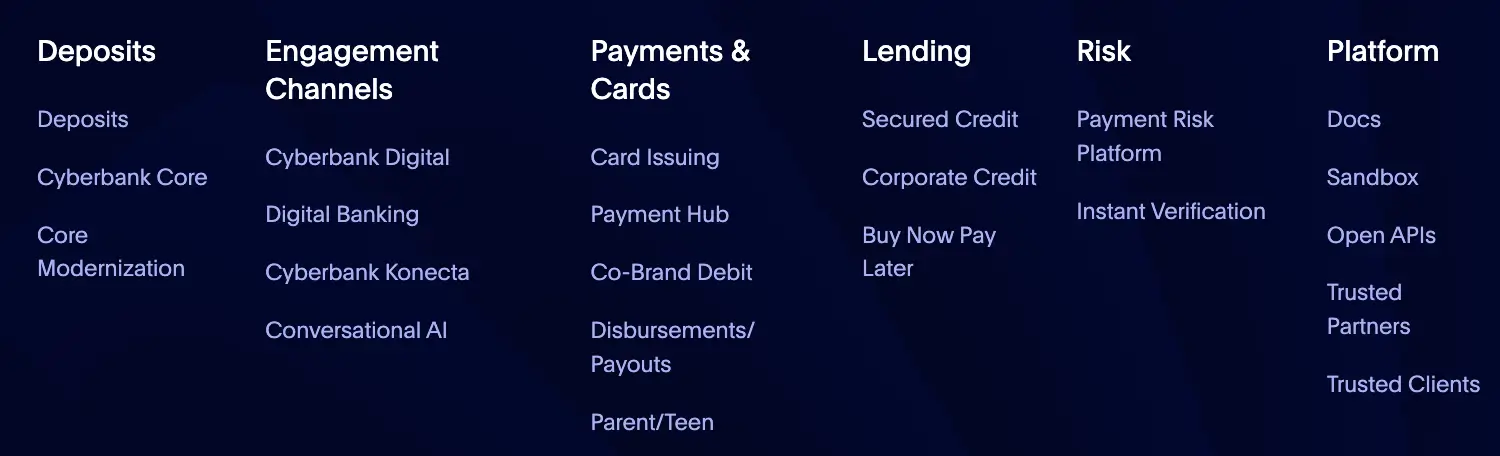
Galileo’s main product groups are Deposits, Engagement Channels, Payments & Cards, Lending, Risk, and Platform. Those categories show that Galileo is not limited to one narrow service. It operates across several parts of modern financial technology.
- Deposits covers tools for modernizing deposits, back-end core infrastructure, and cloud-native migrations.
- Engagement Channels focuses on digital banking tools, including AI-powered features, self-service options, and digital engagement channels.
- Payments & Cards includes card issuing, payment hub services, program management, customer support, and dispute resolution.
- Lending supports credit and lending programs with tools tied to issuing, payment processing, analytics, and risk.
- Risk includes payment risk management, instant verification, and fraud operations support.
- Platform refers to Galileo’s broader cloud-based infrastructure, including open APIs, sandbox testing, and partnerships for banks, fintechs, and brands.
Galileo also highlights specific products such as Cyberbank Core, Cyberbank Digital, Card Issuing, Payment Hub, Secured Credit, and Payment Risk Platform. Together, these products help show why Galileo Financial is broader than just a payments company.
Financial Institutions Using Galileo
Galileo works with a broad mix of financial and technology brands. Clients include Plaid, SoFi, GreenFi, Bluevine, and H&R Block. That range helps show that Galileo Financial is not limited to one corner of fintech. Its client base includes companies connected to consumer finance, business finance, tax services, and financial technology infrastructure.
That variety matters because it makes Galileo easier to understand. It is not just a company serving brand-new startups, and it is not tied to only one type of financial product. Galileo works with a mix of newer fintech brands and more established names, which helps explain why it is better viewed as a platform company than a niche app provider.
From a Utah perspective, SoFi stands out because of its ownership connection to Galileo. Bluevine is another recognizable fintech name, while H&R Block shows that Galileo’s reach extends beyond pure fintech startups into larger consumer-facing financial brands. Together, these examples give a clearer picture of where Galileo Financial fits in the financial technology landscape.
 Read our full Bluevine profile
Competitors
Galileo competes with other companies that provide the infrastructure used to launch and run modern financial products. Its platform spans core banking, card issuing, payment processing, deposits, lending, risk, and APIs, so its competitive set reaches across several parts of fintech infrastructure rather than one narrow niche.
Some of the more relevant competitors include Marqeta in card issuing and modern processing, Stripe Treasury, Treasury Prime, Increase, and Alviere in banking infrastructure and embedded finance, and larger established processors such as Fiserv and TSYS. The broader point is that Galileo Financial competes with both newer API-driven platforms and older financial infrastructure providers.

Platform, Access, and Business Model
Galileo Financial is mainly a business-to-business (B2B) platform. It serves banks, fintechs, and brands that want to launch or expand financial products, rather than marketing itself as a direct consumer app or bank. Galileo’s client examples include traditional banks, digital banks, fintech startups, and non-financial brands embedding payments, accounts, or rewards into their customer experience.
In practice, companies access Galileo through its APIs, platform tools, and client infrastructure. Galileo provides the technology layer for products such as accounts, payments, transfers, and card programs, along with tools tied to fraud, risk, compliance, and reporting. It also emphasizes a developer experience built around APIs, documentation, and sandbox testing.
That means most people never interact with Galileo directly. Instead, they use a bank account, card, wallet, or financial app built by another company that runs on Galileo’s systems. From a business model standpoint, Galileo Financial is best understood as an infrastructure provider that helps other companies bring financial products to market faster.
Why Galileo Matters in Utah
Galileo matters in Utah because it shows that the state’s financial industry is not limited to banks, credit unions, and consumer-facing apps. Utah is also home to companies building the technology infrastructure behind modern financial services.
Galileo’s headquarters are in Sandy near I-15, and the company shares the same building as Mountain America Credit Union. That creates a strong local connection between a major Utah fintech company and one of the state’s best-known credit unions.
Galileo also matters because it represents a different side of finance in Utah. It is not mainly a bank people use directly. Instead, Galileo helps power the systems behind financial products, which shows that Utah’s role in finance includes not only front-facing institutions, but also the technology that supports them.
This also helps show the range within Utah fintech. Infrastructure companies like Galileo work behind the scenes, while companies like BILL operate closer to businesses, helping manage payments and financial workflows.
 Read our full Mountain America Credit Union profile.
Limitations
It is important to understand that Galileo Financial is not mainly a consumer financial brand. Most people will never open an account with Galileo the way they would with a bank, credit union, or finance app. Instead, Galileo provides the infrastructure that other companies use to offer those products.
It is also better not to think of Galileo as only a banking company or only a card processor. Its platform spans accounts, payments, transfers, card issuing, fraud and risk tools, and compliance support, which makes it broader than a single-label description.
Conclusion
Galileo Financial Technologies is a Utah-based company operating in the infrastructure layer of modern finance. From its headquarters in Sandy, Utah, Galileo supports banks, fintechs, and brands with technology tied to payments, card issuing, accounts, and digital financial tools.
For Utah, Galileo stands out because it shows that the state’s financial industry includes more than consumer-facing banks and apps. Galileo Financial represents the side of fintech that builds the systems other companies rely on, which makes it an important part of Utah’s broader financial technology landscape.

Disclaimer:
This page is not affiliated with, maintained by, or sponsored by Galileo Financial. The information provided in this overview may be outdated or inaccurate after the publication date. UtahFi does not assume responsibility for the accuracy of the content. The logo is a registered trademark of Galileo Financial Technologies, LLC.