BILL: Financial Operations Platform
 BILL is a financial technology company that provides software to help businesses manage payments and financial workflows. Headquartered in San Jose, California, the company operates in the business payments and financial operations segment of fintech, with a direct connection to Utah through its acquisition of Divvy, a spend management platform originally built in the state.
The platform is designed to help companies send payments, receive money, and track cash flow in one place. Rather than acting as a bank, BILL provides the software layer that connects business finances with accounting systems and payment networks.
Over time, BILL has expanded beyond payments into broader financial operations. A key step in that evolution came with the acquisition of Divvy, a Utah-based spend management platform that is now part of its core offering.
Today, BILL is widely used by small and mid-sized businesses, accountants, and finance teams, helping replace manual processes like paper checks, email approvals, and disconnected systems with a more structured, digital workflow.
Website: www.bill.com
In Simple Terms
BILL is a tool that helps businesses pay their bills and get paid in a more organized and digital way.
Instead of using paper checks, spreadsheets, or email approvals, businesses can use BILL to track invoices, approve payments, and move money in one system. It brings different parts of financial operations together so companies can see what is coming in, what is going out, and what needs to be done.
Growth
BILL was founded in 2006 in San Jose, California, with the goal of simplifying how businesses handle payments and financial workflows. At the time, many companies relied on paper checks, manual approvals, and disconnected systems. BILL focused on digitizing accounts payable and receivable, helping businesses move money and manage transactions more efficiently.
As businesses adopted digital payments, another challenge became clear: companies still lacked real-time visibility and control over spending.
BILL expanded into that area by acquiring Divvy in 2021, adding expense management and corporate card capabilities to its platform. Divvy was a Utah-based company that became a key part of BILL’s broader financial operations offering.
Divvy was founded in Utah and built its operations along the Wasatch Front, with a strong presence in Lehi and later Draper. It was created after its founders struggled to understand how money was being spent inside their own business. Existing tools focused on past transactions, making it difficult to manage finances in real time. Divvy was built to provide instant visibility into spending, combined with budgets and corporate cards, allowing businesses to control expenses before they happened.
After launching in 2018, Divvy grew quickly among startups and small businesses, particularly in Utah. Following the acquisition, it was integrated into the platform as BILL Spend & Expense, becoming a core part of how BILL helps businesses manage financial operations.
What BILL Does
BILL provides software that helps businesses manage financial workflows, especially around payments and day-to-day financial operations.
It is important to clarify that BILL is not a bank and not a direct lender. Instead, it connects with banks, accounting platforms, and payment networks to help businesses move money and manage transactions more efficiently.
At its core, BILL brings together several key functions into one system:
- Paying vendors through digital payments instead of checks
- Receiving customer payments and tracking incoming money
- Managing invoices and approvals in a structured workflow
- Controlling business spending through tools that originated from Divvy
By combining these functions, BILL helps businesses replace manual processes with a more organized, automated, and real-time financial system, similar to the shift described in Accounts Payable Automation: The Shift to Automated Payments.
Main Products and Services
bill.com | Products and services
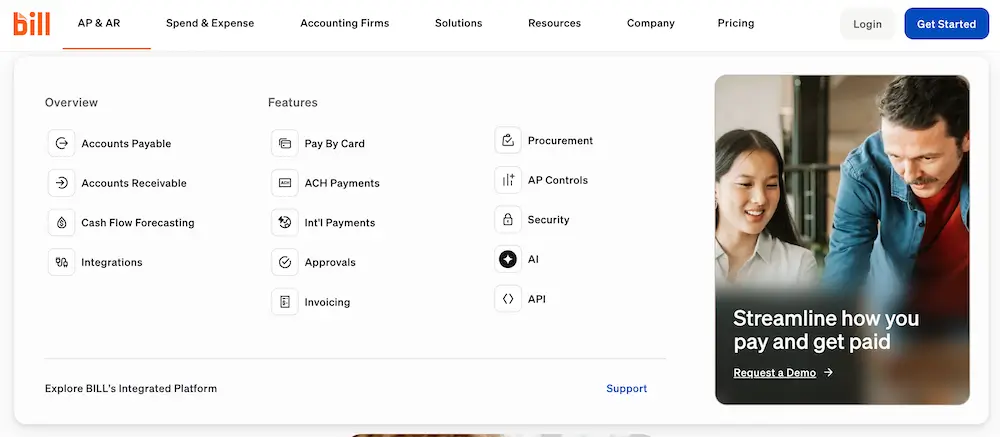
BILL’s platform is organized around a few core areas that work together as a single system for managing business finances:
- Accounts Payable (AP): Tools that help businesses manage and automate outgoing payments, including bill entry, approvals, and vendor payments
- Accounts Receivable (AR): Features that allow businesses to send invoices, receive payments, and track incoming cash flow
- Expense Management: Tools for controlling and tracking business spending through BILL Spend & Expense, which includes budgets, cards, and real-time visibility
- Cash Flow Management: A centralized view of money coming in and going out, helping businesses understand and manage their financial position
These services are designed to work together, giving businesses a more complete view of their financial operations rather than using separate tools for each task.
Companies Using BILL
BILL is primarily used by:
- Small and mid-sized businesses
- Accounting firms and bookkeepers
- Finance teams managing multiple clients or entities
Bill is often used alongside accounting software like QuickBooks, helping businesses connect payments and workflows directly to their financial records.
In the broader fintech ecosystem, BILL complements platforms like Lendio and Nav. While those platforms focus on funding and credit access, BILL focuses on managing day-to-day financial operations, making it part of a larger set of tools businesses use to run their finances.
Competitors
BILL operates in a competitive space that includes platforms focused on business payments, expense management, and financial automation.
Some of the main competitors include:
- Melio: Focuses on small business payments, especially accounts payable
- Brex: Offers corporate cards combined with financial tools for startups and growing companies
- Ramp: Provides expense management and corporate cards with a focus on cost control
- Tipalti: Targets more complex payment operations, including global payables and compliance
These platforms approach the problem from different angles, but all aim to simplify how businesses manage money, spending, and financial workflows.

Platform, Access, and Business Model
BILL operates as a software-as-a-service platform designed for businesses.
Companies access the platform through a web interface and connect it to their bank accounts and accounting software. This allows BILL to sit in the middle of financial operations, organizing workflows without replacing the underlying financial institutions.
The platform is typically used on an ongoing basis as part of daily operations, rather than as a one-time tool. Businesses rely on it to manage payments, track financial activity, and automate routine tasks.
BILL’s business model is based on subscription software combined with transaction-related services, meaning companies pay to use the platform and for certain payment-related activities.
Why BILL Matters in Utah
BILL has a presence in Utah through its acquisition of Divvy, a spend management platform originally founded in Lehi and later headquartered in Draper.
Before the acquisition, Divvy was widely used by startups and small businesses across the state for expense management and corporate cards, helping establish it as one of Utah’s notable fintech companies.
After acquiring Divvy in 2021, BILL maintained that presence in Draper. While Divvy no longer operates as a standalone company, it now lives on as BILL Spend & Expense, making it a core part of BILL’s platform and its connection to Utah.
BILL also connects to Utah through banking partners like WebBank and WEX Bank, which are part of the state’s broader financial ecosystem. Its role alongside companies like MX, LoanPro and SoFi Tech Solutions highlights how different parts of fintech infrastructure connect across the state.
Limitations
BILL is designed for businesses, not individual consumers. People looking for personal banking, budgeting, or everyday payment apps will not find it relevant.
It also focuses on payments and financial workflows, not lending or credit decisions. Businesses that need financing or credit access will typically need to use other platforms alongside BILL.
Conclusion
BILL is best understood as a business payments and financial operations platform that brings together multiple parts of a company’s financial workflow into one system.
Its value comes from replacing manual processes with a more organized, automated, and real-time approach to managing money. With the addition of spend management through BILL Spend & Expense, the platform now covers a broader range of financial operations.
While it does not provide banking or lending directly, BILL plays an important role in helping businesses run their financial operations more efficiently, especially when combined with other tools in the fintech ecosystem.

Disclaimer:
This page is not affiliated with, maintained by, or sponsored by Bill. The information provided in this overview may be outdated or inaccurate after the publication date. UtahFi does not assume responsibility for the accuracy of the content. The logo is a registered trademark of Bill.