Route: Package Tracking Platform
 Route is a Utah-based fintech platform focused on package tracking and delivery protection for e-commerce purchases. Legally known as Route App Inc and headquartered in Lehi, the company operates in the post-purchase layer of digital commerce.
The company does not provide banking, lending, or payment processing. Instead, it helps customers track orders and protect shipments against issues like loss, theft, or damage.
The platform is commonly integrated into online stores, especially among e-commerce brands and direct-to-consumer businesses, helping improve the delivery experience after checkout.
Website: www.route.com
In Simple Terms
Route helps businesses and their customers track online orders and protect shipments after a purchase is made.
For customers, it brings orders into one place and shows where a package is and when it will arrive. For businesses, it helps reduce issues related to lost, stolen, or delayed deliveries by offering tracking visibility and optional protection.

Growth
Route was founded in 2019 in Lehi, Utah, to address a gap in e-commerce: what happens after a customer clicks “buy.” At the time, most merchants relied on carriers for tracking and had limited tools to manage delivery issues.
The company gained traction by combining multi-carrier package tracking with built-in order protection, giving merchants more control over the delivery experience. Early adoption came from direct-to-consumer brands, where customer experience and repeat purchases are critical.
Within a few years, Route expanded to support thousands of merchant partners and a growing network of shoppers, while also opening offices outside Utah, including Los Angeles.
A major milestone came in 2022, when Route raised a $200 million funding round, reaching a valuation of about $1.25 billion. In the startup world, companies valued at $1 billion or more are often called “unicorns.”
More recently, the company entered a new phase of growth, including a CEO transition in 2025, with Eric Kobe taking over leadership.
What Route Does
Route provides a platform that connects e-commerce purchases with delivery tracking and protection services.
It is important to understand that Route is not a bank, not a lender, and not a payment processor. Its role begins after a transaction is completed, focusing on the delivery stage of the purchase journey.
The platform allows businesses to:
- Track shipments across multiple carriers
- Centralize delivery updates for customers
- Offer optional protection for lost, stolen, or damaged packages
By doing this, Route helps merchants manage delivery-related issues without relying entirely on shipping carriers, while giving customers more visibility and control after checkout.
Route operates within the broader category of post-purchase platforms, which centralize the experience after a purchase is made. For a deeper explanation, see Post-Purchase Platforms: Managing Experience After Checkout.
Within the broader fintech ecosystem, Route fits alongside platforms like SoFi Tech Solutions, which power financial systems, and MX, which organize financial data. Route focuses instead on what happens after a purchase is made, connecting the transaction to the delivery experience.
Main Products and Services
route.com | Products and services
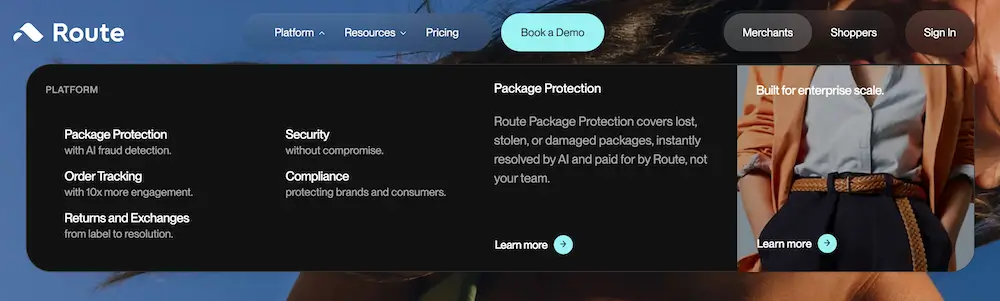
Route’s products focus on the post-purchase stage of e-commerce, helping businesses manage delivery, communication, and order-related issues after checkout.
- Package Tracking Platform: Aggregates tracking information across multiple carriers into a single view, giving customers and businesses real-time visibility into shipments.
- Delivery Protection: Offers optional coverage for lost, stolen, or damaged packages, allowing issues to be resolved without relying entirely on shipping carriers.
- Returns and Order Resolution Tools: Helps businesses manage returns, delivery problems, claims, and replacements, reducing the need for manual support.
- Post-Purchase Experience Tools: Includes features that improve communication after checkout, such as updates, notifications, and customer engagement.
These services are typically integrated directly into the checkout and post-checkout flow, making Route part of the overall purchase experience rather than a separate tool.
Companies Using Route
Route is primarily used by e-commerce businesses, especially direct-to-consumer brands and online retailers that want to improve the post-purchase experience.
The platform has been adopted by thousands of merchant partners across categories such as athletic wear, lifestyle brands, and consumer goods. Public examples include companies like APL and Alo Yoga (athletic wear), Solo Stove (outdoor products), Cotopaxi (apparel and gear), Cuts Clothing (menswear), and the Utah Jazz (sports merchandise).
Route is typically integrated directly into online stores, often without being the main focus of the customer experience, but playing a role in tracking, communication, and delivery protection after a purchase is made.
Competitors
Route operates in the post-purchase space alongside other e-commerce and delivery experience platforms that help businesses manage shipments, customer communication, and order tracking.
Some of the main competitors include:
- AfterShip (shipment tracking platform)
- Narvar (post-purchase experience platform)
- ParcelLab (delivery experience platform)
- Seel (shipping protection platform)
These platforms focus on different parts of the post-purchase experience. Route’s positioning comes from combining tracking and protection into a single platform, rather than offering only one of these functions.

Platform, Access, and Business Model
Route operates as a platform integrated directly into e-commerce stores, becoming part of the checkout and post-purchase experience rather than a separate tool.
Businesses connect Route to their order systems, allowing customers to track shipments and access delivery protection after a purchase is made. The platform works across a broad logistics network, supporting over 1,100 shipping carriers, including major providers like FedEx, UPS, USPS, and Amazon.
Route follows a B2B model with a consumer-facing layer. Merchants use the platform to manage delivery-related issues, while customers interact with it through tracking pages, notifications, or the mobile app. This allows Route to operate in the background while still shaping the overall delivery experience.
Why Route Matters in Utah
Route is part of Utah’s growing fintech ecosystem, particularly in the Lehi and Silicon Slopes area, where many technology companies are based.
While many Utah fintech companies focus on areas like financial data, lending, and infrastructure, Route represents a different part of the market by focusing on the post-purchase side of e-commerce. That makes it a useful contrast to companies like MX and Lendio, which are also based in Lehi.
Its presence shows that Utah’s fintech sector is not limited to bank technology or lending tools. It also includes platforms that support the customer experience around digital transactions, including what happens after a purchase is completed.
Limitations
Compared with some competitors, Route is more focused on package tracking and protection than on the full post-purchase experience. Other platforms in this space may place more emphasis on returns, branded communications, personalization, or broader customer engagement tools.
Route can also add checkout friction because package protection is usually presented as an extra option with an added cost. For some merchants, that may be worth it. For others, it may create another decision point for customers during checkout.
For businesses comparing platforms, Route may be a stronger fit when tracking and protection are the priority, but a less complete fit if the goal is a broader post-purchase operations and customer experience platform.
Conclusion
Route is a fintech platform focused on package tracking and delivery protection, helping businesses manage the post-purchase experience after a customer completes a purchase.
It stands out by combining tracking and protection into a single platform, making it a strong fit for e-commerce businesses that want more control over delivery and customer experience.
Within the broader fintech ecosystem, Route plays a specialized role. It does not replace infrastructure, data, or lending platforms, but instead complements them by improving what happens after a transaction is completed.

Disclaimer:
This page is not affiliated with, maintained by, or sponsored by Route. The information provided in this overview may be outdated or inaccurate after the publication date. UtahFi does not assume responsibility for the accuracy of the content. The logo is a registered trademark of Route App Inc.