Utah Bankers Association: Overview and Role in Utah Banking
 The Utah Bankers Association (UBA) is a trade association representing banks operating in Utah. Founded in 1908, the organization supports the state’s banking industry through legislative advocacy, professional education, industry representation, and collaboration among financial institutions.
Based in Salt Lake City, UBA serves as a connection between its member banks, policymakers, regulators, and other banking industry participants. Its activities help shape discussions about banking policy, industry practices, and professional development throughout Utah.
The Utah Bankers Association represents Utah’s banking industry, while Utah’s Credit Unions serves as the statewide trade association for credit unions. Both organizations provide industry advocacy, education, and professional development for their respective members.
Headquarters and Official Website
Headquarters: 175 South Main Street, Suite 1420, Salt Lake City, UT 84111
Official Website: Utah Bankers Association
In Simple Terms
The Utah Bankers Association (UBA) is a group that represents banks in Utah. It helps banks work together, trains bank employees, and speaks with lawmakers about banking issues. It is not a bank or a government agency.
Table of Contents
History of the Utah Bankers Association
The Utah Bankers Association was established in 1908 to represent Utah’s banking industry. With more than a century of history, the association has served as a forum for banks to communicate, share resources, and address issues affecting their operations.
Over time, UBA’s activities have included legislative advocacy, banking education, professional development, and industry collaboration. The association has also supported communication among banking professionals through committees, conferences, and its official publication, Utah Banker.
Today, UBA continues to represent commercial banks, savings banks, and industrial banks operating in Utah, maintaining its longstanding role as a statewide banking trade association.

What Does the Utah Bankers Association Do?
The Utah Bankers Association (UBA) supports its member banks through several activities designed to address industry challenges, share knowledge, and encourage cooperation.
Its principal activities include:
- Industry advocacy: Communicating with lawmakers and regulators about legislation and policies affecting banks.
- Professional education: Providing training, conferences, and development programs for banking employees and executives.
- Member resources: Offering access to industry information, compliance resources, and services that support banking operations.
- Industry collaboration: Bringing banking professionals together through committees, meetings, and networking opportunities.
- Financial education: Supporting initiatives that improve public understanding of banking and personal finance.
UBA also organizes committees focused on areas such as regulatory compliance, agriculture, technology, and financial literacy. These groups allow banking professionals to exchange information and address issues relevant to their work.
The association’s services are primarily intended for its members and banking professionals, rather than individual consumers.

Membership and Representation
The Utah Bankers Association represents a range of banks and banking-related businesses operating in Utah. Membership is open to eligible FDIC-insured financial institutions, including national banks, state banks, savings banks, and industrial banks conducting business in the state.
Banks do not have to be headquartered in Utah to qualify. The association’s membership includes local community banks, regional institutions, nationally operating banks, and Utah-based industrial banks.
Membership Categories
The Utah Bankers Association offers several membership categories:
- Member Banks: FDIC-insured banks and other eligible banking institutions doing business in Utah.
- Associate Members: Companies that provide products or services to the banking industry, such as technology providers, consultants, and professional service firms.
- Affiliate Members: Financial institutions that do not have insured deposits in Utah but otherwise meet the association’s membership eligibility requirements.
- De Novo Members: Groups working to establish a new bank that have reached specified stages in the regulatory application process.
The association also operates its Emerging Bank Leaders program, which provides networking, mentoring, and professional development opportunities for current and future banking professionals.
Representation of Utah Banks
Through its membership, the Utah Bankers Association provides a forum for banks to discuss industry developments, participate in committees, and communicate shared concerns to policymakers and regulators.
Members include institutions such as Zions Bank, Bank of Utah, Cache Valley Bank, Chase Bank, and SoFi Bank, illustrating the variety of banks represented by the association.
Membership does not mean that every bank agrees with every position taken by the Utah Bankers Association. The association advocates for its members’ interests while individual institutions maintain their own business operations and policies.
Additional information is available through the association’s official member bank directory.
Banks vs. Credit Unions: Industry Representation
The Utah Bankers Association represents banks, not credit unions. Credit unions have their own statewide trade association, Utah’s Credit Unions, which provides industry representation, advocacy, education, and professional development for its member credit unions.

Advocacy and Public Policy
The Utah Bankers Association (UBA) represents the interests of its member banks in legislative and regulatory discussions at the state and federal levels. The association communicates with lawmakers, government agencies, and banking regulators about policies that may affect financial institutions operating in Utah.
Legislative Advocacy
UBA monitors banking-related legislation and participates in public policy discussions through several activities:
- Legislative monitoring: Tracking proposed laws affecting banks and financial services.
- Government relations: Communicating with elected officials about banking industry concerns.
- Bankers Day at the Legislature: Bringing banking professionals together with Utah lawmakers.
- Federal advocacy: Organizing visits to Washington, D.C., to discuss banking issues with members of Congress and federal regulators.
- Grassroots engagement: Encouraging member banks to participate in public policy discussions.
UBA also publishes legislative tracking information that identifies banking-related bills and the association’s positions or monitoring activities.
Regulatory Engagement
In addition to legislative advocacy, UBA communicates with banking regulators about proposed rules and regulatory requirements affecting its members.
These activities give member banks opportunities to raise concerns about regulatory compliance, banking operations, and industry developments.
UBA does not create or enforce banking regulations. Its role is to communicate industry perspectives, while government agencies retain responsibility for supervision and enforcement.
The association’s advocacy reflects the interests of its members and does not necessarily represent the positions of every bank or banking customer.
Additional information is available through UBA’s official advocacy resources.

Education, Events, and Industry Resources
UBA provides educational programs, conferences, and professional development opportunities for banking professionals at different career stages. Its offerings cover topics such as bank management, commercial lending, regulatory compliance, leadership, and financial technology.
Banking Education and Development Programs
UBA offers several specialized programs designed to strengthen technical skills and prepare banking professionals for additional responsibilities.
These include:
- Executive Development Program: Prepares experienced banking professionals for leadership and executive responsibilities.
- Management Development Program: Focuses on management skills, leadership, and banking operations.
- Credit Analyst Development Program: Covers commercial credit analysis, lending structures, and related compliance requirements.
- Commercial Lending Development Program: Provides training in commercial lending, credit evaluation, and loan management.
UBA also provides access to webinars, online banking courses, and professional certification resources, including training offered through the American Bankers Association (ABA) and other education partners.
Conferences and Industry Events
The association organizes and participates in conferences and events where banking professionals discuss industry developments, regulatory requirements, and emerging challenges.
Examples include:
- UBA Annual Convention: Brings together banking executives, directors, and industry professionals to discuss developments affecting the banking industry.
- Women in Banking Conference: Focuses on leadership, professional development, and networking opportunities for women in banking.
- Fall Compliance Conference: Addresses regulatory compliance requirements and challenges facing financial institutions.
- Community Reinvestment Conference: Covers community reinvestment, regulatory requirements, and community development.
- Emerging Bank Leaders Conference: Provides leadership development and networking opportunities for banking professionals.
- AI-Native Banking & Fintech Conference: A specialized event co-hosted by UBA and Spring Labs, focused on artificial intelligence, banking innovation, financial technology, and related regulatory considerations.
- Ag Outlook & Conference: Examines agricultural lending, economic conditions, financing strategies, and developments affecting Utah’s agricultural industry.
These events provide opportunities for continuing education, professional networking, and discussions with industry specialists and regulators. Conference availability and schedules may change.
Additional Industry Resources
Beyond formal education, UBA provides access to industry publications, training resources, and professional networking opportunities. Its Utah Banker magazine covers banking industry developments, while its Emerging Bank Leaders initiative supports mentoring, networking, and career development.
Information about available programs and events is published through UBA’s official Education and Events section.
Utah Bankers Association vs. Utah Department of Financial Institutions
The Utah Bankers Association and the Utah Department of Financial Institutions both have important roles in Utah’s banking industry, but they serve different purposes.
The Utah Bankers Association represents the interests of its member banks, while the Utah Department of Financial Institutions (DFI) is a state government agency responsible for regulating and supervising financial institutions under its jurisdiction.
Key Differences
| Utah Bankers Association | Utah Department of Financial Institutions |
|---|---|
| Banking industry trade association | Utah government regulatory agency |
| Represents member banks | Oversees institutions under its regulatory authority |
| Advocates on legislative and regulatory issues | Enforces applicable banking laws and regulations |
| Provides banking education and industry events | Conducts regulatory examinations and supervision |
| Does not issue banking charters | Charters eligible state financial institutions |
| Does not have regulatory enforcement authority | Has enforcement authority under applicable law |
How the Organizations Interact
The Utah Bankers Association communicates with state and federal banking regulators about proposed regulations, banking legislation, and industry concerns. These discussions allow the association to present the perspectives of its member banks without exercising regulatory authority.
The Utah Department of Financial Institutions (DFI) supervises Utah state-chartered banks and other financial institutions under its jurisdiction. Federal regulators, including the FDIC, Federal Reserve, and OCC, have separate supervisory responsibilities determined by federal law and an institution’s charter.
DFI and federal regulators also coordinate supervision and share regulatory information for certain financial institutions. The Utah Bankers Association participates in policy discussions but does not conduct regulatory examinations or enforcement actions.
The following infographic illustrates how Utah banks, their industry association, and state and federal regulators interact.
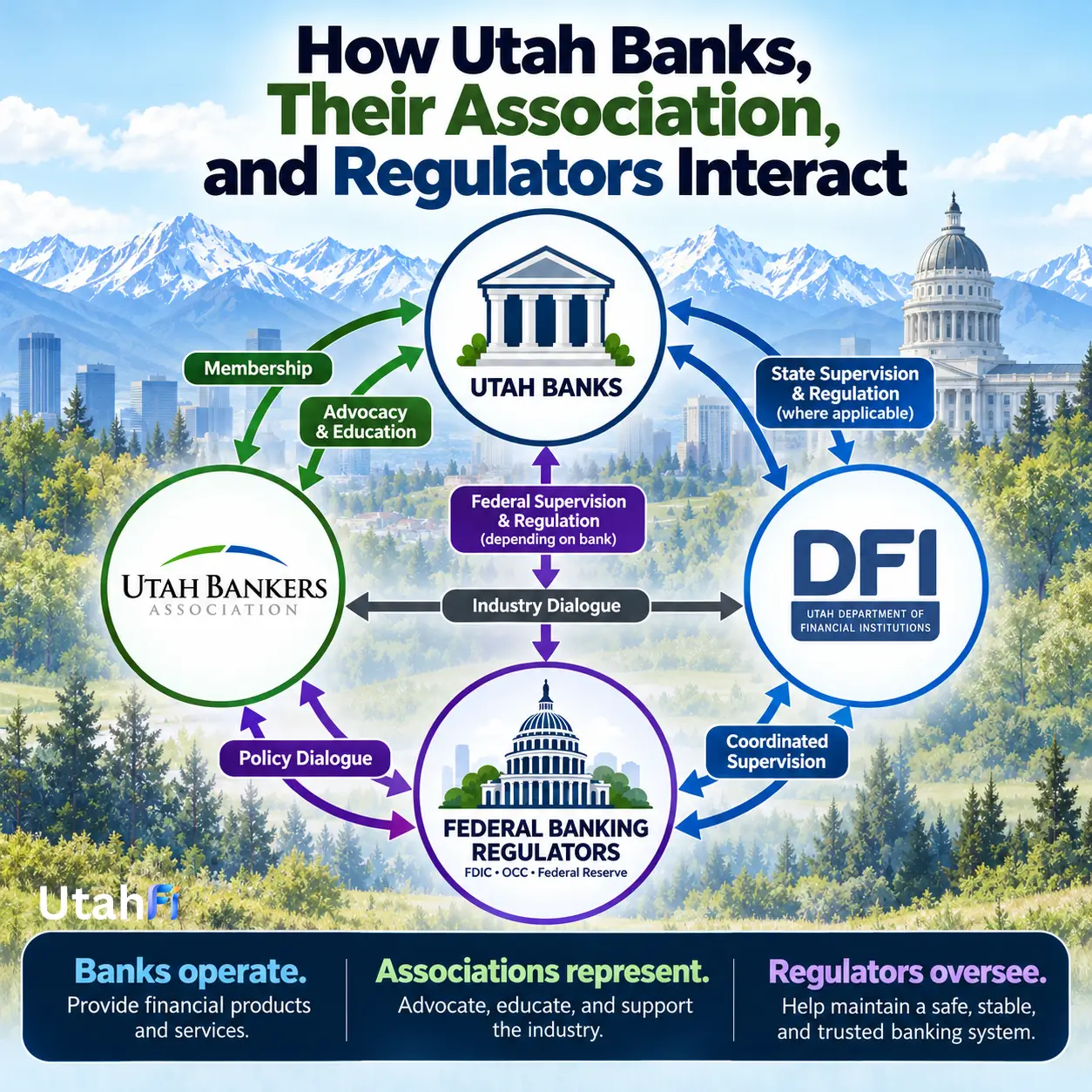
How Utah banks, the Utah Bankers Association, DFI, and federal banking regulators interact
Additional information about the state’s regulatory responsibilities is available through the Utah Department of Financial Institutions’ official mission statement.
Frequently Asked Questions
What is the Utah Bankers Association?
The Utah Bankers Association is a trade association representing banks operating in Utah. Founded in 1908, it supports member institutions through legislative advocacy, professional education, industry events, and networking opportunities.
Is the Utah Bankers Association a government agency?
No. The Utah Bankers Association is an industry trade association, not a government agency. It represents member banks but does not regulate financial institutions or enforce banking laws.
Who can join the Utah Bankers Association?
Membership is available to eligible banks operating in Utah, including commercial banks, savings banks, and industrial banks. The association also offers membership categories for banking service providers, qualifying financial institutions, and groups working to establish new banks.
Does the Utah Bankers Association represent credit unions?
No. The Utah Bankers Association represents banks, not credit unions. Credit unions have their own statewide trade association, Utah’s Credit Unions, which provides advocacy, education, and industry representation for its member credit unions.
Does the Utah Bankers Association offer financial services to consumers?
No. The Utah Bankers Association does not provide personal checking accounts, savings accounts, loans, or credit cards. Those services are offered by individual financial institutions. The association focuses on representing and supporting its members.
Conclusion
Since its establishment in 1908, the Utah Bankers Association has played a longstanding role in representing and supporting Utah’s banking industry. Through legislative advocacy, professional education, industry events, and collaboration, the association provides a platform for banks to address shared challenges and participate in discussions affecting financial services.
Although the association does not regulate financial institutions or provide banking services directly, it serves as an important connection between member banks, policymakers, and regulators. Its activities contribute to the broader network of organizations that shape Utah’s banking industry.