Utah’s Credit Unions: Overview and Role in Utah’s Credit Union Industry
 Utah’s Credit Unions is the public-facing identity of the Utah Credit Union Association, a statewide trade association dedicated to supporting and representing credit unions operating in Utah. Established in 1934, the organization advocates for the interests of its member institutions while providing educational programs, professional resources, and opportunities for industry collaboration.
Headquartered in Salt Lake City, Utah’s Credit Unions works to strengthen the state’s credit union industry by engaging with lawmakers, addressing regulatory issues, and helping member institutions navigate an evolving financial environment. Unlike individual credit unions, the association does not offer financial products or services directly to consumers.
While Utah’s Credit Unions represents the credit union industry, the Utah Bankers Association serves a similar role for banks operating in Utah.
Headquarters and Official Website
Headquarters: 455 East 500 South, Suite 400, Salt Lake City, UT 84111
Official Website: utahscreditunions.org
In Simple Terms
Utah’s Credit Unions is a trade association that represents and supports credit unions in Utah. It helps member credit unions work together, communicate with lawmakers, and access professional training and industry resources. Unlike a credit union, it does not offer checking accounts, savings accounts, or loans to consumers.
History of Utah’s Credit Unions
The history of Utah’s Credit Unions dates to 1934, when representatives of 12 credit unions gathered at the Art Barn in Salt Lake City to establish a statewide organization. The founding meeting brought together 24 participants who worked to elect officers and develop a constitution and bylaws, laying the foundation for organized credit union representation in Utah.
Originally known as the League of Utah Credit Unions, the organization later adopted the name Utah League of Credit Unions. During its early decades, it supported the expansion of Utah’s credit union movement, helping institutions collaborate, share resources, and advance the cooperative financial model.
In 2015, the organization approved a formal name change to Utah Credit Union Association, reflecting its role as a statewide industry association. The organization subsequently adopted Utah’s Credit Unions as its public-facing brand while retaining the association name in official materials.
Over the decades, its work has evolved alongside Utah’s credit union industry. What began as an effort to organize and support a relatively small group of credit unions has developed into an association providing legislative advocacy, regulatory engagement, professional education, and operational resources to participating institutions.
The association’s historical records and annual reports document its development and the changing landscape of Utah’s credit union industry.

What Does Utah’s Credit Unions Do?
Utah’s Credit Unions provides advocacy, professional support, and industry resources to its member credit unions. Its activities are organized around two primary functions: representing credit union interests and helping participating institutions operate effectively.
The association’s principal responsibilities include:
- Legislative advocacy: Monitors proposed state and federal legislation, communicates credit union industry positions to lawmakers, and advocates for policies affecting member institutions.
- Regulatory engagement: Communicates with the Utah Department of Financial Institutions (DFI), National Credit Union Administration (NCUA), and other authorities about regulatory requirements and industry concerns.
- Professional education: Organizes training programs, workshops, and conferences covering leadership, compliance, operations, and other credit union topics.
- Compliance assistance: Provides member institutions with access to regulatory information, compliance resources, and professional guidance.
- Operational support: Offers consulting and resources addressing financial reporting, cybersecurity, organizational management, and other operational needs.
- Industry collaboration: Creates opportunities for credit union executives, employees, and volunteers to exchange knowledge and discuss shared challenges.
- Public representation: Communicates credit union industry perspectives on financial policy and issues affecting cooperative financial institutions.
These activities primarily benefit member credit unions and their personnel. Utah’s Credit Unions does not supervise financial institutions, enforce banking laws, or provide financial products directly to consumers.

Membership and Representation
Membership in Utah’s Credit Unions is available to credit unions that maintain a headquarters or branch in Utah. The association brings together participating institutions of different sizes and charter types, providing a collective voice for credit unions operating throughout the state.
Unlike individual credit union membership, which allows people and businesses to access financial services, association membership is intended for credit union institutions. Eligible credit unions become members through affiliation and payment of association dues.
Member Credit Unions
Utah’s Credit Unions represents institutions of different sizes, from large statewide credit unions to smaller organizations with strong community or occupational ties.
Examples of smaller and mid-sized member credit unions include:
- Alpine Credit Union: Based in Orem, with roots in serving Alpine School District employees and a branch network concentrated in Utah County.
- Wasatch Peaks Credit Union: Headquartered in Ogden, serving members primarily in Weber, Davis, and Morgan counties.
- Utah Power Credit Union: Headquartered in Murray, with historical ties to Utah’s electric-power industry and membership focused on qualifying employees, retirees, and families.
The association’s membership includes credit unions of diverse sizes, from large statewide institutions to smaller organizations serving specific communities or occupational groups. For a complete list of member institutions, visit Utah’s Credit Unions’ official credit union directory.
Industry Representation and Governance
Member credit unions participate in the association’s governance through voting rights and opportunities for their employees and volunteers to serve on its board of directors.
This structure allows institutions of different sizes to participate in organizational decisions and industry representation.
Through its membership network, Utah’s Credit Unions provides a forum for institutions to discuss shared concerns, exchange professional knowledge, and coordinate positions on issues affecting the credit union industry.

Advocacy and Public Policy
Advocacy is one of the primary responsibilities of Utah’s Credit Unions. The association represents the interests of member credit unions in legislative and regulatory discussions, helping policymakers understand how proposed laws, regulations, and government decisions may affect credit union operations.
Its advocacy activities take place at both the state and federal levels, including:
- Utah legislative advocacy: Monitors legislation considered by the Utah Legislature, evaluates potential effects on credit unions, and communicates industry positions to state lawmakers.
- Federal legislative advocacy: Works with national credit union organizations, including America’s Credit Unions, to engage members of Congress on financial legislation and credit union policy.
- Regulatory policy engagement: Communicates with the Utah Department of Financial Institutions (DFI), National Credit Union Administration (NCUA), and other authorities about proposed rules, supervisory issues, and regulatory requirements.
- Industry coordination: Brings credit union representatives together to discuss policy concerns, develop shared positions, and participate in advocacy initiatives.
- Public policy communication: Provides information about the credit union industry’s structure, cooperative business model, and perspectives on financial policy.
Utah’s Credit Unions also provides legislative updates and advocacy resources to help participating institutions follow policy developments affecting their operations.
Although the association communicates with lawmakers and regulators, it does not have government regulatory authority. Its role is to advocate for member institutions, while government agencies are responsible for establishing, administering, and enforcing applicable financial regulations.
The association maintains an official resource center with legislative information and advocacy materials.

Education, Events, and Industry Resources
Utah’s Credit Unions provides professional education, leadership development, and industry resources to help member credit unions strengthen their operations and support their employees and volunteers. Its programs cover topics such as regulatory compliance, financial operations, management, governance, and emerging industry challenges.
Training opportunities include in-person workshops, virtual sessions, webinars, and conferences. The association also works with other credit union organizations to make additional educational resources available to participating institutions.
Conferences and Industry Events
The association organizes several conferences and professional gatherings throughout the year, including:
- Credit Union Summit: Its largest annual conference, bringing together credit union executives, employees, managers, volunteers, and industry service providers for educational presentations, exhibits, and networking.
- Executive Summit: A leadership-focused gathering combining educational sessions, executive discussions, and professional networking.
- Volunteer Summit: Provides education for credit union board members and volunteers, with an emphasis on governance, organizational oversight, and leadership.
- Chair/CEO Pre-meeting: A specialized gathering held in connection with the Volunteer Summit, focusing on strategic issues affecting credit union leadership.
- Small Credit Union Conference: An educational gathering designed for smaller credit unions and their particular operational and management needs.
These events provide opportunities to exchange ideas, discuss industry developments, and build professional relationships.
The association also maintains an official conference information page covering its principal gatherings.
Professional Development and Training
In addition to conferences, Utah’s Credit Unions offers several specialized programs:
- Ignite Leadership Series: Virtual leadership education designed for professionals ranging from frontline supervisors to senior executives.
- Compliance training: Educational sessions covering regulatory requirements and compliance responsibilities.
- IRA training: Instruction on individual retirement account administration and related procedures.
- @Lunch Networking: Professional roundtables that bring together credit union personnel working in similar operational areas.
- eTrain webinars: Online educational programs offered in collaboration with the California and Nevada credit union leagues.
The association’s professional development page provides additional information about these training opportunities.
Industry Publications and Resources
Utah’s Credit Unions also provides annual reports, professional resources, industry information, and educational materials to support member institutions.
Its online resource center includes information related to professional development, credit union operations, volunteer responsibilities, and industry initiatives. These materials complement the association’s advocacy and training activities.
Additional information is available through its official resource center.
Utah’s Credit Unions vs. Utah Department of Financial Institutions
Utah’s Credit Unions and the Utah Department of Financial Institutions (DFI) both play important roles in Utah’s credit union industry, but their responsibilities are fundamentally different.
Utah’s Credit Unions represents and supports its member credit unions through advocacy, education, and industry collaboration. The Utah Department of Financial Institutions is a state government agency responsible for regulating and supervising Utah state-chartered credit unions and other financial institutions under its jurisdiction.
Key Differences
| Utah’s Credit Unions | Utah Department of Financial Institutions |
|---|---|
| Credit union industry trade association | Utah government regulatory agency |
| Represents member credit unions | Regulates Utah state-chartered credit unions |
| Advocates on legislative and regulatory issues | Administers and enforces applicable state financial laws |
| Provides professional education and industry events | Conducts regulatory examinations and supervision |
| Does not issue credit union charters | Charters eligible Utah state credit unions |
| Does not have regulatory enforcement authority | Has enforcement authority under applicable state law |
How the Organizations Interact
Utah’s Credit Unions communicates with state and federal policymakers and regulators about legislation, proposed regulations, and issues affecting member credit unions. These discussions allow the association to present industry perspectives without exercising government regulatory authority.
The Utah Department of Financial Institutions (DFI) serves as the primary state regulator for Utah state-chartered credit unions. At the federal level, the National Credit Union Administration (NCUA) charters and supervises federally chartered credit unions and administers the federal share insurance program.
For federally insured, Utah state-chartered credit unions, DFI retains primary regulatory responsibility while NCUA exercises additional oversight related to federal share insurance. The two agencies may coordinate examinations, supervisory activities, and regulatory information sharing.
Although Utah’s Credit Unions participates in policy discussions with regulators, it does not conduct examinations, issue charters, or take regulatory enforcement actions.
The following infographic illustrates how Utah credit unions, their industry association, and state and federal regulators interact.
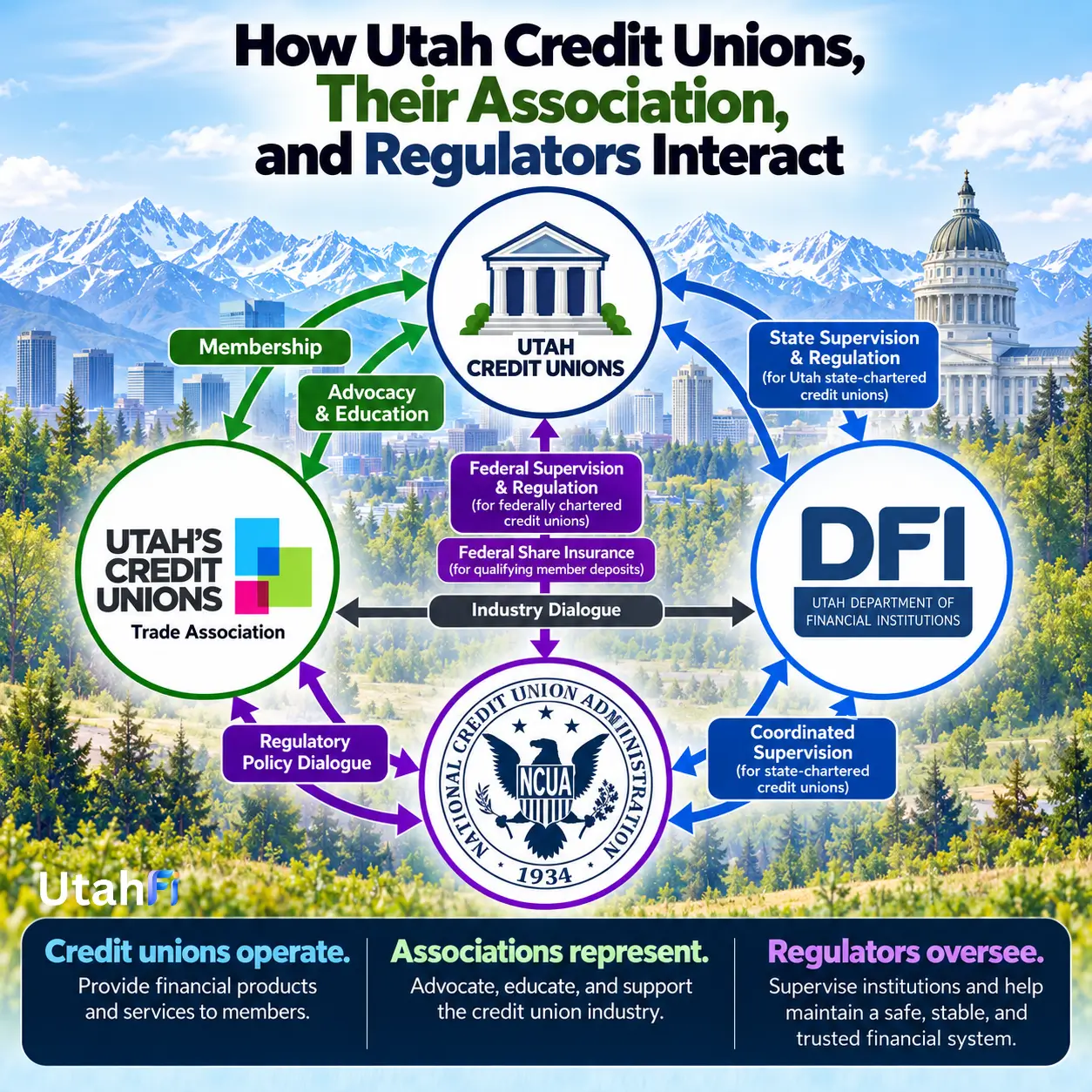
How Utah credit unions, Utah’s Credit Unions, the Utah Department of Financial Institutions, and the NCUA interact through advocacy, membership, and regulatory oversight.
Additional information about credit union oversight is available through the Utah Department of Financial Institutions’ credit union information and the NCUA’s regulatory and supervisory resources.
Frequently Asked Questions
What is Utah’s Credit Unions?
Utah’s Credit Unions is the public-facing identity of the Utah Credit Union Association, a statewide trade association established in 1934. It represents member credit unions through advocacy, professional education, regulatory engagement, and industry support.
Is Utah’s Credit Unions a financial institution?
No. Utah’s Credit Unions is a trade association, not a credit union or bank. It does not offer checking accounts, savings accounts, loans, or other financial products to consumers.
Who can join Utah’s Credit Unions?
Credit unions with a headquarters or branch in Utah are eligible to apply for association membership. Membership provides access to industry representation, educational programs, professional resources, and opportunities to participate in association governance.
Does Utah’s Credit Unions regulate credit unions?
No. The association has no regulatory or enforcement authority. Utah state-chartered credit unions are primarily regulated by the Utah Department of Financial Institutions, while federally chartered credit unions are regulated by the National Credit Union Administration.
Does Utah’s Credit Unions provide training and conferences?
Yes. The association offers professional development programs, regulatory compliance training, leadership education, and industry conferences for credit union employees, executives, and volunteers.
Conclusion
Utah’s Credit Unions has played a role in Utah’s credit union industry since 1934, providing a collective voice for member institutions and supporting their development through advocacy, education, and professional collaboration.
As Utah’s credit union industry continues to evolve, the association serves as a connection between financial cooperatives, policymakers, and regulatory authorities. Its work helps member credit unions address shared challenges, participate in policy discussions, and access resources that support their operations.
Although it does not provide financial services or exercise regulatory authority, Utah’s Credit Unions remains an important part of Utah’s financial landscape, representing institutions of different sizes and serving communities and membership groups throughout the state.