Introduction
When starting a small business, one of the first practical steps is opening a business bank account. Before doing that, many business owners must decide how their business will be structured. Two of the most common options are operating as a sole proprietor or forming a single-member LLC.
Both structures are widely used by freelancers, consultants, contractors, and small business owners. However, banks and credit unions often treat them slightly differently when opening a business account, particularly when it comes to documentation, tax identification numbers, and business registration.
Understanding single-member LLC vs sole proprietor for business banking can help avoid delays when opening an account and ensure you bring the correct documents. For a broader look at the process, it can also help to review how to open a business bank account in Utah.

What Is a Sole Proprietor?
A sole proprietor is the simplest business structure. It means one individual owns and operates the business without creating a separate legal entity.
From a legal and tax perspective, the business and the owner are the same person. Business income and expenses are usually reported on the owner’s personal tax return, and there is no separate business entity registered with the state.
For business banking, this usually means the account is tied directly to the individual owner. Banks typically verify the owner’s identity and basic business information when opening the account.
Common characteristics of a sole proprietorship include:
- • The business is owned by one person
- • No separate legal entity exists
- • Income is reported on the owner’s personal taxes
- • Business banking may use the owner’s name or a registered business name
If the business operates under a name different from the owner’s legal name, banks usually require a DBA (Doing Business As) registration. This allows the financial institution to open the account using the business name instead of the owner’s personal name. More details are explained in What Is a DBA and Do You Need One to Open a Business Account in Utah.
Because this structure is simple, the paperwork required by banks is usually minimal, which can make opening a business account faster.
What Is a Single-Member LLC?
A single-member LLC (Limited Liability Company) is a business structure where one person owns the company, but the business is legally separate from the owner.
Another reason banks treat LLCs differently is because the company has its own legal identity separate from the owner. This means the business can enter contracts, hold assets, and open financial accounts under its own name. When opening a business account, the bank verifies that the LLC was properly formed and that the person opening the account has authority to act on behalf of the company.
Even though the company has only one owner, the LLC is considered its own legal entity under state law. In Utah, LLCs are formed by filing Articles of Organization with the Utah Division of Corporations.
Because the LLC exists as a separate entity, banks and credit unions usually require business formation documents before opening a business account.
Common documents requested include:
- • Articles of Organization
- • Operating Agreement
- • Employer Identification Number (EIN)
- • Owner identification
Many single-member LLCs obtain an EIN because banks frequently require one when opening a business account. Business owners can apply for an EIN on the IRS website in a few minutes at no cost.
One reason business owners choose an LLC is that it can provide liability protection, meaning personal assets may be separated from business liabilities depending on how the business is operated.

Single-Member LLC vs Sole Proprietor for Business Banking
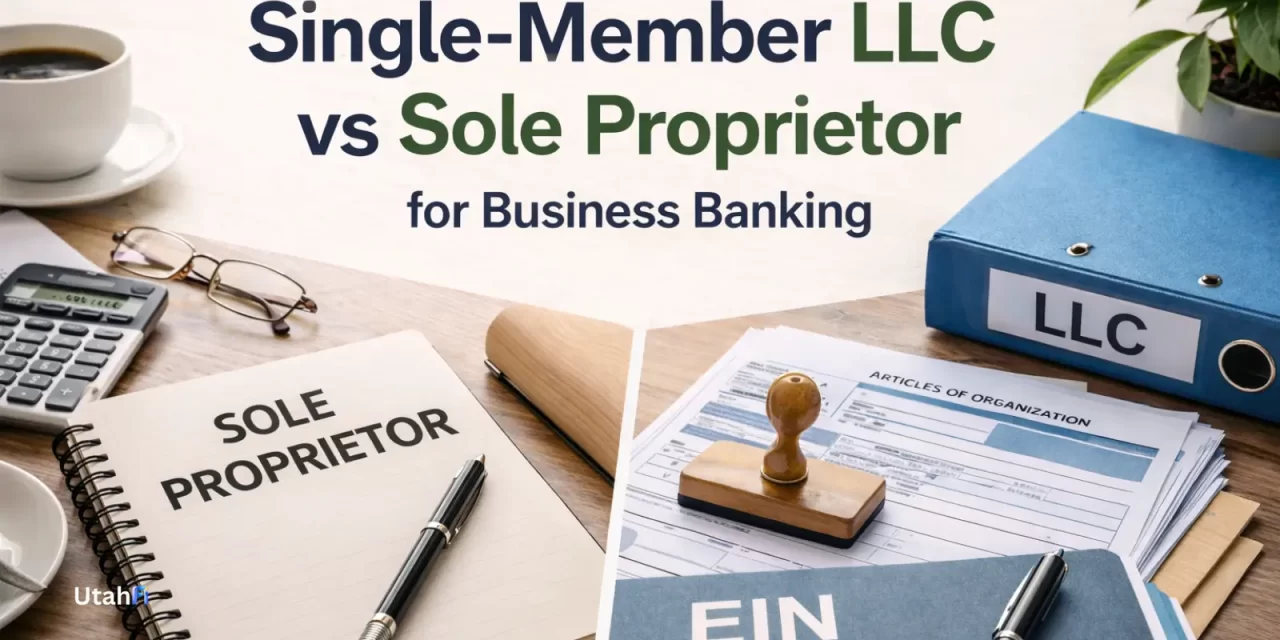
When comparing LLC vs sole proprietor for business banking, the main differences usually involve documentation, account ownership, and legal structure.
Another practical difference when comparing LLC vs sole proprietor for business banking is how financial institutions view the business. A sole proprietorship is closely tied to the individual owner, while an LLC is recognized as a separate business entity. Because of this, banks may ask additional questions when opening an LLC account, such as verifying ownership structure, formation documents, and tax identification numbers. These extra steps help the bank confirm that the business is properly registered and authorized to operate.
A sole proprietor business account is usually connected directly to the individual owner. This often means:
- Fewer documents are required
- The account may be opened with government identification and basic business details
- A DBA registration may be required if the business operates under a different name
A single-member LLC account, on the other hand, is opened in the name of the LLC itself. Because the LLC is a separate entity, banks typically require additional documentation.
These documents often include:
- Articles of Organization
- Ownership documentation or operating agreement
- EIN or tax identification number
In practice, this means LLC accounts often involve slightly more paperwork, but they also reflect the separate legal identity of the business.
Do Banks Prefer an LLC or a Sole Proprietor?
Banks and credit unions generally do not require a specific business structure to open a business account. Both sole proprietors and single-member LLCs can open business banking accounts.
For many small business owners, the question is not just about legal structure but about how that choice affects account opening. Understanding single-member LLC vs sole proprietor for business banking helps clarify why one option may require more paperwork, while the other may be faster and simpler to set up.
However, the verification process may differ.
With a sole proprietorship, banks usually verify the individual owner directly, which can make the process simpler. With an LLC, banks verify the business entity and its ownership, which typically requires reviewing formation documents.
Some financial institutions also require an EIN for LLC accounts, even if the business has only one owner.
Although banks do not necessarily prefer one structure over the other, many business owners choose an LLC because it can make the business appear more formal and established when dealing with vendors, lenders, or financial institutions.
In many cases, the decision between these structures is not driven by the bank itself but by how the business owner wants to operate the business. Some owners start as sole proprietors for simplicity, then later create an LLC as the business grows or begins handling larger contracts, employees, or higher financial risk.
Read our guide for Best Business Checking Accounts in Utah if you are looking for a business account.

Which Structure Is Simpler for Business Banking?
From a banking perspective, a sole proprietorship is usually the simplest structure.
Opening the account may only require:
- Government-issued identification
- Basic business information
- DBA registration if using a business name
A single-member LLC typically involves additional preparation before opening the account. Business owners usually need to:
- Register the business with the state
- Obtain an EIN
- Prepare formation documents
- Provide ownership information
Even though the process can be slightly more involved, many business owners still choose the LLC structure because of its liability protection and more formal business identity.
Final thoughts
Choosing between single-member LLC vs sole proprietor for business banking often depends on how the business is structured and how formal the owner wants the business to be.
A sole proprietorship is easier to start and typically requires fewer documents when opening a business account. A single-member LLC requires more paperwork, but it creates a separate legal entity, which can provide liability protection and a more formal business structure.
Regardless of the structure chosen, keeping business finances separate from personal finances is one of the most important habits for managing a small business.
Before opening an account, it helps to understand what documents banks usually require and how business structure affects the process. Reviewing what documents you need to open a business bank account in Utah can help prepare everything in advance and make the process smoother.