Atomic: Payroll Connectivity and Income Platform
 Atomic Fi, Inc. is a Utah-based fintech company that connects payroll systems with financial applications. The platform enables other companies to access employment and income data directly from payroll providers, supporting features like income verification, direct deposit switching, and other payroll-linked financial tools.
Atomic operates in the fintech infrastructure layer, meaning its technology is used by banks, fintechs, and digital platforms rather than by consumers directly. Its focus is on making payroll data easier to access and use within modern financial experiences.
By enabling real-time payroll connectivity, Atomic plays a role in the shift toward embedded finance, where financial services are integrated directly into apps and workflows.
In Simple Terms
Atomic helps apps connect directly to your paycheck.
If a financial app needs to verify your income, switch your direct deposit, or build features based on your earnings, Atomic provides the connection to your employer’s payroll system. This removes the need for manual uploads or outdated documents.
Atomic acts as the bridge between payroll systems and financial apps, making it easier for companies to use real-time employment and income data.
Growth
Atomic was founded in 2019 by Jordan Wright and Scott Weinert, who previously co-founded Unbill, a company acquired by Q2 Holdings. As they set out to build Atomic, they were joined by Andrea Martone, forming a founding team with experience in financial infrastructure and open finance.
Early in its development, Atomic participated in Y Combinator, which helped the company refine its product and connect with fintech companies building modern financial services.
From the beginning, Atomic focused on solving a key gap in fintech: the lack of direct access to payroll data for financial applications. Early solutions often relied on indirect methods like bank transaction analysis or uploaded documents to estimate income, which could be incomplete or outdated.
Atomic gained traction by building direct integrations with payroll systems, allowing financial platforms to access verified income and employment data more efficiently. Over time, the company expanded its capabilities to support use cases such as direct deposit switching, income verification, and access to tax and payroll-related data.
As demand for real-time financial data increased, Atomic grew into a broader payroll connectivity platform, supporting millions of users annually and working with a significant share of large U.S. financial institutions. Its growth has been driven by deeper integrations and expanding use cases within embedded finance.
What Atomic Does
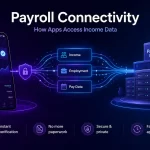
Atomic provides payroll connectivity infrastructure that allows financial applications to access and use employment and income data directly from payroll systems. These capabilities are part of a broader shift toward direct access to income and employment data, as explained in Payroll Connectivity: How Apps Access Income Data.
Instead of offering financial services directly, Atomic enables other companies to build features that depend on payroll data, helping replace processes that traditionally relied on manual documents or indirect data sources.
Through these connections, Atomic supports use cases such as income verification, direct deposit switching, and other payroll-linked financial tools integrated into digital financial experiences. These types of capabilities are often used alongside platforms like LoanPro in lending workflows or Nav in credit-related decision-making.
In this role, Atomic operates in the backend layer of fintech, acting as a bridge between payroll providers and financial platforms. Its technology helps make financial processes faster, more automated, and more reliable by enabling access to real-time employment and income data.
Main Products and Services
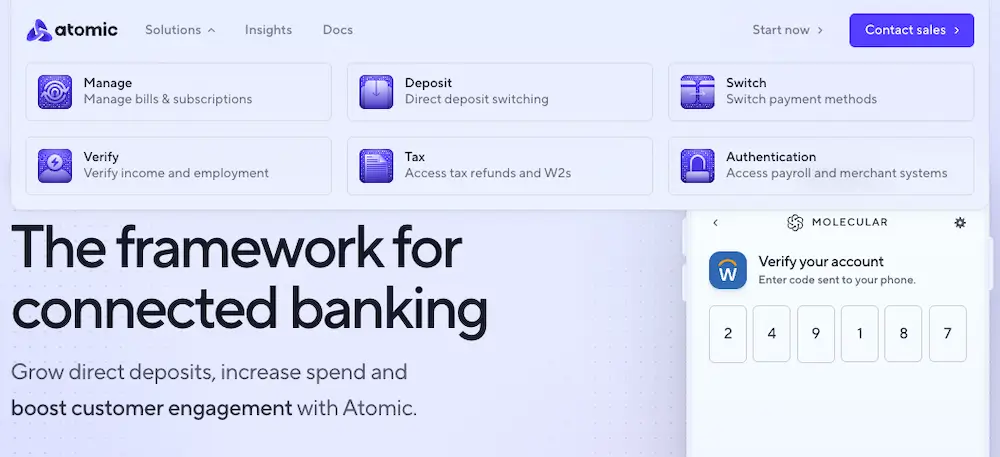
atomic.financial | Products
Atomic offers a set of tools focused on payroll connectivity and income data access for financial platforms.
- Payroll connectivity
- Income and employment verification
- Direct deposit switching
- Tax and payroll data access
- Authentication and account linking
These capabilities are delivered through APIs and embedded components that other companies integrate into their platforms.
Companies Using Atomic
Atomic works with a range of fintech companies, financial institutions, and digital platforms that rely on payroll and income data to power their services.
Examples of companies operating in this space include:
- Neobanks and fintech apps: Chime, Robinhood, and MoneyLion
- Financial institutions and partners: Capital One and Citi Ventures
- Embedded finance and investing platforms: NerdWallet and Yieldstreet
These examples reflect the types of companies integrating payroll connectivity into their products, particularly to support features like direct deposit switching, income verification, and account funding.
Atomic’s technology is also used in workflows such as:
- Direct deposit switching, including integrations with platforms like Galileo Financial.
- Recurring payment management, through partnerships with utilities, insurance providers, and subscription services
- Embedded investing and financial tools, often working alongside data platforms like MX
While public materials highlight these companies and use cases, they may represent partnerships, integrations, or examples within Atomic’s ecosystem, rather than a complete or confirmed customer list.
Competitors
Atomic operates in a specialized segment focused on payroll connectivity and income data infrastructure. Companies in related or overlapping areas include:
- Plaid – Primarily aggregates bank account data, including some income insights derived from transactions
- Argyle – Focuses on direct payroll connections for income and employment data
- Pinwheel – Specializes in payroll-linked financial services and direct deposit switching
- Finicity (Mastercard) – Provides financial data aggregation, including income and asset verification
- Truework – Focuses on employment and income verification for lending and screening
While these companies overlap in areas like income and employment data, they differ in how that data is sourced and used, with some relying on bank data and others, like Atomic, focusing more on direct payroll integrations.

Platform, Access, and Business Model
Atomic operates as a B2B fintech infrastructure platform, providing tools that other companies integrate into their own applications.
Its services are delivered through APIs and embedded components, allowing fintech apps, banks, and digital platforms to connect directly to payroll systems within their user experience. This enables features like direct deposit switching and income verification to be completed inside an app rather than through manual processes.
This approach is similar to how platforms like Galileo Financial Technologies provide banking and payments infrastructure, but with a focus on payroll and employment data.
Atomic’s business model is based on enabling other companies to build financial experiences on top of its connectivity layer, making it part of the broader embedded finance ecosystem.
Why Atomic Matters in Utah
Atomic contributes to Utah’s position as a growing fintech infrastructure hub, where many companies focus on building the systems that power modern financial services.
Alongside platforms like MX, Galileo Financial Technologies, and LoanPro, Atomic represents a category of companies working behind the scenes rather than directly with consumers.
Its focus on payroll connectivity and income data adds another layer to Utah’s fintech ecosystem, helping enable services tied to employment, earnings, and financial access.
Limitations
Atomic focuses specifically on payroll connectivity and income data, which means it is more specialized than some competitors. Platforms like Plaid and Finicity offer broader financial data coverage, including bank account aggregation, assets, and transaction history.
Compared to companies like Argyle and Pinwheel, which also connect directly to payroll systems, the differences often come down to coverage, integrations, and specific use cases, depending on the platform and employer systems involved.
Atomic is also not a direct consumer product, so its value depends on how well it is integrated into other applications. This means the end-user experience can vary based on the platform using it.
Conclusion
Atomic is a fintech infrastructure company focused on connecting payroll systems with financial applications. Its technology enables faster and more reliable access to income and employment data, supporting features like direct deposit switching and income verification within modern financial platforms.
By specializing in payroll connectivity, Atomic plays a specific role within the broader fintech ecosystem, working alongside other infrastructure and data providers to enable embedded finance experiences. From a Utah perspective, it represents the type of company helping build the behind-the-scenes systems that power the next generation of financial services.

Disclaimer:
This page is not affiliated with, maintained by, or sponsored by Atomic. The information provided in this overview may be outdated or inaccurate after the publication date. UtahFi does not assume responsibility for the accuracy of the content. The logo is a registered trademark of Atomic Fi, Inc.