
What Is Embedded Finance
Embedded finance is the shift where financial services are built directly into apps and platforms, instead of being accessed through a separate bank or financial institution.
Instead of going to a bank’s website or app to manage money, payments, lending, investing, and accounts now happen inside the apps people already use. These services are integrated into everyday digital experiences like shopping, driving, or running a business.
This shift aligns with digital-first banking, where financial services are designed to be accessed primarily through apps and online platforms. For a deeper explanation, see Digital-First Banking: How Online Platforms Are Changing.
In Simple Terms
In simple terms, embedded finance means the bank comes to you instead of you going to the bank.
Before, if you wanted to pay, borrow, or manage money, you had to leave what you were doing and open a bank app.
Now, those same actions happen inside the app you are already using.

What Changed (Before vs Now)
For decades, financial services followed a separate, centralized model.
Before:
- You opened a bank account at a bank
- You used a bank app or branch for transactions
- Payments, loans, and accounts were controlled and delivered by banks directly
- Every financial action required switching to a financial institution
Now:
- Financial services are distributed across platforms
- Apps integrate payments, accounts, and lending directly
- Banks often operate behind the scenes
- Users interact with apps, not financial institutions
This shift moves finance from a standalone system to an embedded layer inside digital products.
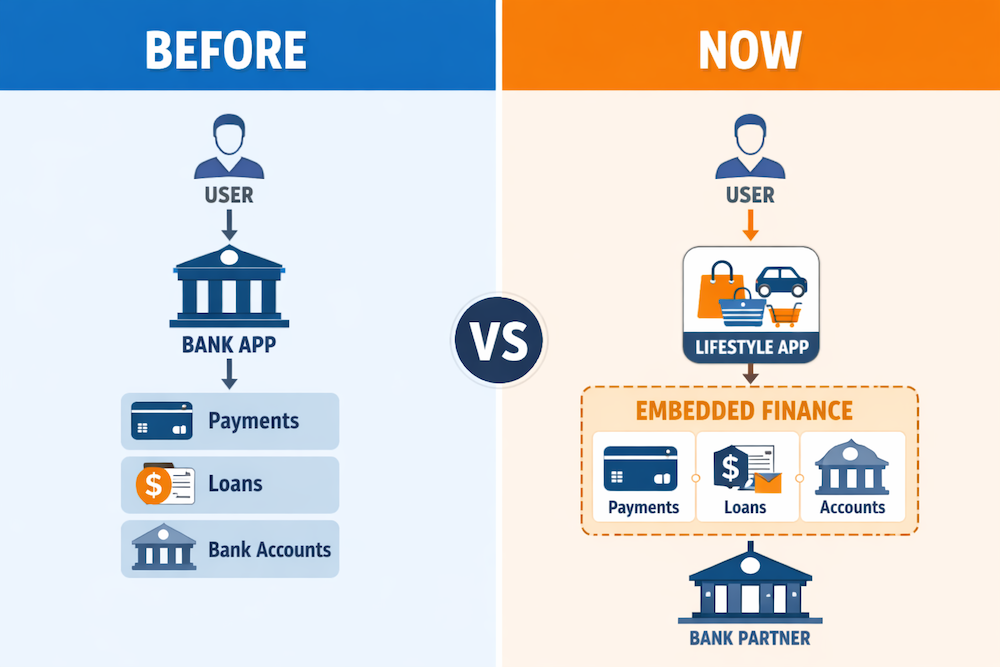
Traditional banking vs embedded finance inside apps
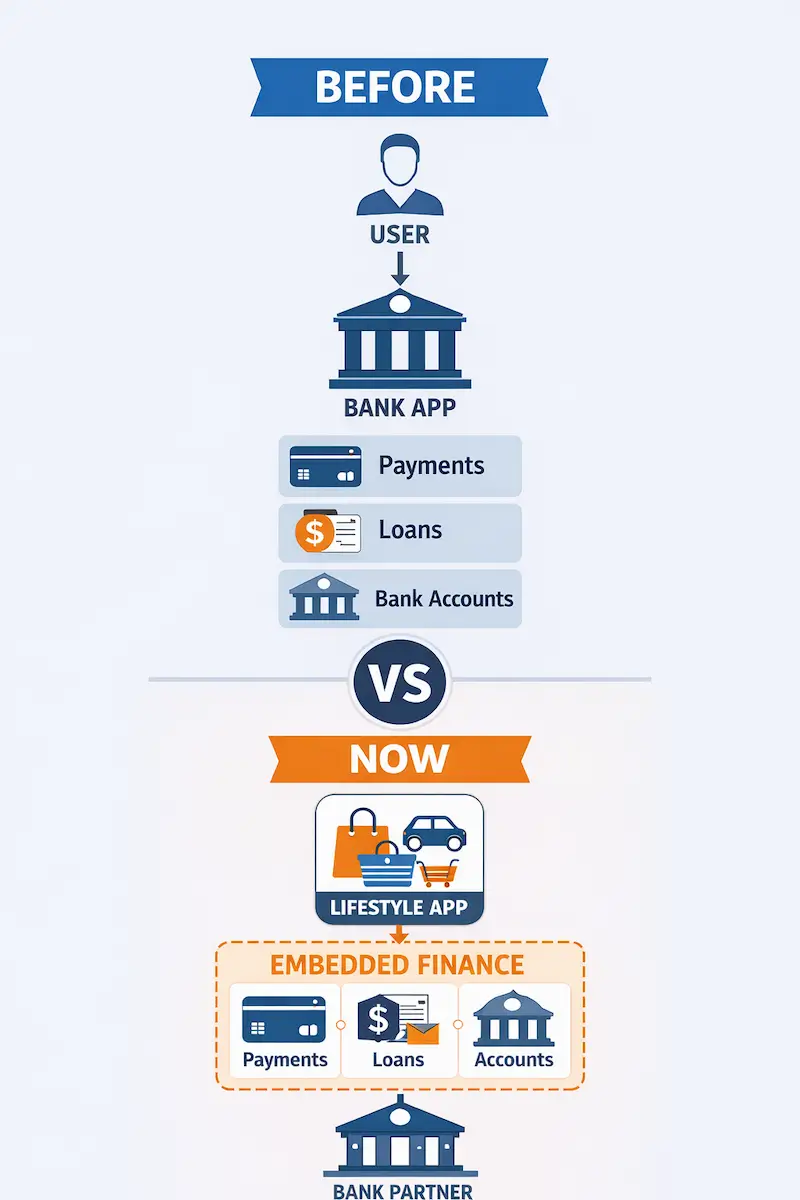
Traditional banking vs embedded finance inside apps
Examples of Embedded Finance
Many of the most widely used apps already include embedded finance features.
- Uber lets drivers receive earnings, access payouts, and use a debit card within the app
- Shopify offers merchant accounts, payments, and business financing
- Amazon provides payments and credit options
- Robinhood combines investing, cash management, and payments
These companies are not traditional banks, yet they offer core financial services as part of their product experience.
A real-world example shows how this works behind the scenes:
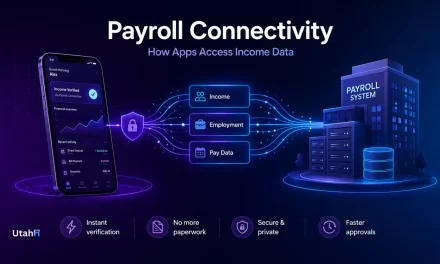
Drivers using Uber can receive earnings and use a debit card directly within the app. This experience is powered by fintech platforms like Branch, supported by banking partners such as Evolve Bank & Trust, and connected to payment networks like Mastercard. Some of these experiences also rely on payroll connections for income data, as explored in Payroll Connectivity: How Apps Access Income Data.
Another example highlights the infrastructure layer:
Chime relies on infrastructure from Galileo Financial Technologies to power accounts, payments, and card services, while partner banks handle the regulated banking layer.
SoFi also uses Galileo Financial Technologies, which it owns, to support many of its financial services, highlighting the role of Utah-based infrastructure in modern finance.
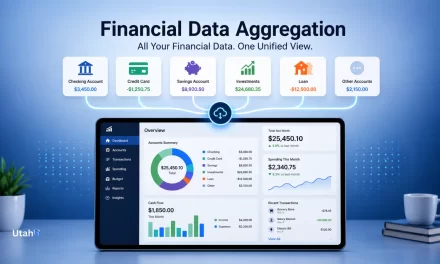
These experiences depend on financial data being combined from multiple accounts into a single view, as explained in Financial Data Aggregation: The Rise of Connected Financial Data.

How Embedded Finance Works
Embedded finance depends on a multi-layered system of technology and partnerships.
At a high level, it works through:
- APIs and integrations that connect apps to financial services
- Fintech platforms that enable features like payments, accounts, and lending
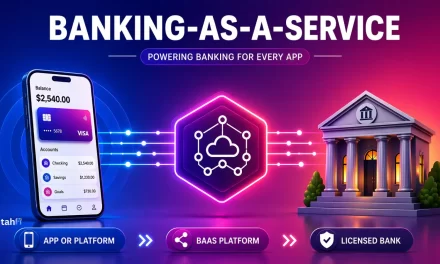
- Banking partners that provide the regulated financial infrastructure, often through banking as a service.
A simplified way to think about it is in layers:
- App layer → where the user interacts (for example, a rideshare or shopping app)
- Fintech layer → where financial features are enabled and managed
- Bank layer → where money is held and regulated
These layers work together to deliver financial services inside apps without requiring users to interact with a traditional bank directly.
These systems increasingly rely on shared data through Open Finance: How Financial Data Is Becoming Shareable and Portable, which allows apps to access and use financial information across platforms.
Key Players and Competitors
Embedded finance is supported by a mix of fintech platforms and infrastructure providers that enable apps to offer financial services.
Utah-based companies include:
- Galileo Financial — provides infrastructure that powers accounts, payments, and card issuing inside apps
- MX Technologies — supports financial data connectivity, insights, and user experience tools that enhance embedded financial features
- Atomic — enables payroll data access, income verification, and direct deposit switching
These companies focus on enabling other platforms to offer financial services, rather than offering them directly to consumers.
Competitors and similar providers include:
- Stripe — provides payments, issuing, and embedded financial services infrastructure
- Marqeta — enables card programs and embedded payment experiences
- Plaid — connects apps to financial accounts and data
- Adyen — supports payments and financial services across global platforms
Each of these companies provides part of the infrastructure needed to embed financial services into digital products.

Why It Matters
Embedded finance is changing how people interact with money by making financial services faster, simpler, and more integrated into everyday life.
- Faster and more convenient: Financial actions happen instantly within the app experience, without switching platforms
- Less friction: Users no longer need to open separate banking apps or re-enter information
- Expanded access: More people can access financial services through apps they already use
- Better user experience: Finance becomes part of a seamless digital journey instead of a separate task
This shift makes financial services more accessible and more aligned with how people already use digital products.
Embedded Finance in Utah
Utah plays a role in embedded finance by providing the infrastructure that powers financial features inside apps.
Companies like Galileo, MX, and Atomic are based in Utah and support capabilities such as payments, account connections, and payroll-linked services.
Other companies, such as Plaid, also have operations in Utah, contributing to data connectivity and financial integrations.
This positions Utah as part of the underlying infrastructure that enables embedded finance.
Limitations
Despite its advantages, embedded finance has tradeoffs.
- Limited visibility: Users may not know which companies provide the service or where their money is held
- Multiple dependencies: The experience relies on fintech platforms, banks, and networks working together
- Complex backend: Several systems, integrations, and partners operate behind the scenes
- Reduced transparency: Fees, protections, and responsibilities are not always clear to the user
- Data sharing and privacy: Multiple providers may have access to user data, increasing exposure across different systems
Embedded finance simplifies the experience on the front end, but adds complexity behind the scenes.

What’s Next (Future of Embedded Finance)
Embedded finance is still evolving, with several trends shaping its future.
- More apps offering financial services: Financial features will continue expanding into non-financial platforms
- Deeper integration: Financial tools will become more personalized and built directly into user workflows
- AI + embedded finance: Automation will enable smarter payments, lending decisions, and financial management, as explained in AI in Finance: How Artificial Intelligence Is Changing Money
- Expansion across industries: Sectors like healthcare, real estate, and education are likely to adopt embedded finance models
- Small business financing integrated directly into platforms, including small business loan marketplaces
The direction is clear: financial services are becoming an invisible layer inside digital experiences.
Conclusion
Embedded finance represents a shift in how financial services are delivered.
Instead of going to a bank for every transaction, financial tools are now built directly into the apps people already use.
This moves finance from a separate destination to an integrated feature, powered by fintech platforms, infrastructure providers, and banking partners.
As this model expands, embedded finance is making financial services faster, more accessible, and more connected to everyday digital experiences.
Disclaimer: Information in this article is for educational purposes and may change over time.