
HealthEquity: HSA and Benefits Administration Platform
 HealthEquity is a fintech company focused on health savings and employee benefit accounts, based in Draper, Utah. It operates a platform used by employers and health plans to manage healthcare-related funds.
The company supports Health Savings Accounts (HSAs) and other tax-advantaged benefit programs, helping organizations handle contributions, reimbursements, and account management in one place. For many users, HealthEquity is the system they interact with when checking balances or paying for medical expenses through their employer benefits.
In Simple Terms
HealthEquity helps people manage money set aside for healthcare.
They can use it to pay for doctor visits, prescriptions, and other medical expenses, and to see how much they have left.
Most people get it through their job, and it works as one place to store and use their healthcare money.
Growth
HealthEquity was founded in 2002 in Draper, Utah, with a focus on helping people better manage healthcare costs through dedicated savings accounts. The idea started earlier, when founder Stephen Neeleman began exploring ways to connect healthcare spending with personal finance.
As Health Savings Accounts (HSAs) became more widely available in the early 2000s, HealthEquity positioned itself as a platform to help employers and health plans offer and manage those accounts more effectively.
The company gained early traction through partnerships with health plans and employers, launching its first HSA solution in 2004. In 2010, it completed its first acquisition with First HSA, marking an early step in expanding its platform.
A key milestone came in 2014 when HealthEquity went public and began trading on the NASDAQ. Another major step came in 2019 with the acquisition of WageWorks, which expanded its role into broader benefits administration.
What HealthEquity Does
HealthEquity operates in the benefits administration layer of fintech, focusing on how healthcare-related money is managed and used.
Its platform helps organizations set up and manage accounts for healthcare spending, including tracking contributions, handling reimbursements, and processing payments. It connects employers, health plans, and administrators so these accounts work smoothly for both businesses and users.
This puts HealthEquity in a different part of the fintech ecosystem than companies like Galileo Financial Technologies and MX, which focus more on banking infrastructure and financial data. HealthEquity’s role is more about running the system behind healthcare benefits, not everyday banking.
Instead of building general financial tools, the company focuses on making healthcare-related funds easier to manage within employer benefit programs.
Main Products and Services
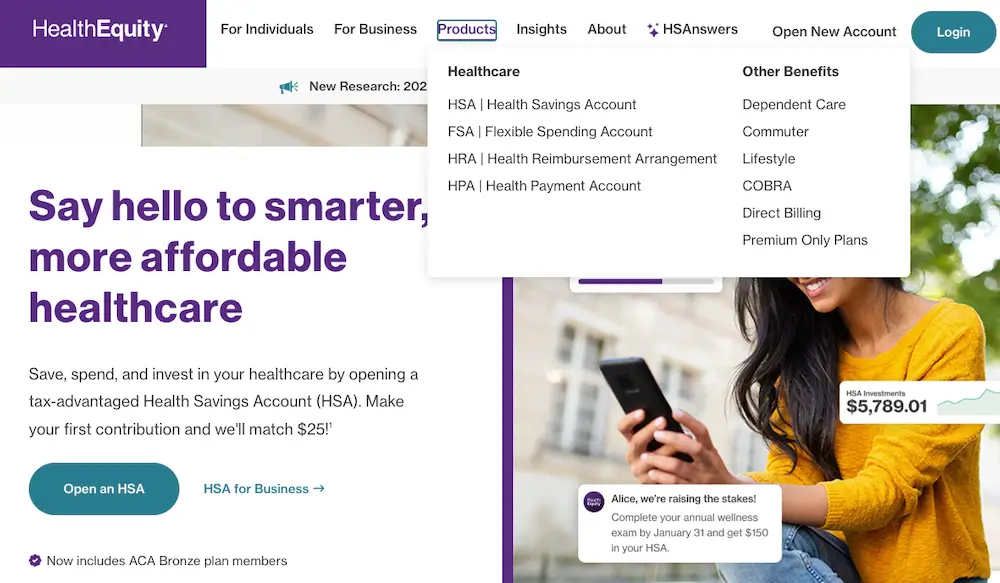
healthequity.com | Products
HealthEquity provides a range of benefit-related accounts and services, including:
- Health Savings Accounts (HSAs)
- Flexible Spending Accounts (FSAs)
- Health Reimbursement Arrangements (HRAs)
- COBRA, which lets people keep their employer health insurance after leaving a job
- Dependent care and commuter benefits
- Employer-sponsored lifestyle spending accounts
These are offered through a single platform that helps employers and partners manage multiple benefit programs in one place, while giving users a simple way to access and use their healthcare funds.
Companies Using HealthEquity
HealthEquity is mainly used by employers, health plans, and benefits administrators.
Typical users of the platform include:
- Employers offering healthcare benefits
- Health insurance providers
- Third-party administrators (companies that manage benefits for employers)
- Benefits advisors and consultants
The company works with a large network of partners, including major health plans and benefits providers such as Blue Cross Blue Shield organizations and Anthem, along with thousands of employers across the United States.
Most individuals do not choose HealthEquity directly. Instead, they use it because it is part of their employer’s benefits setup.
Competitors
HealthEquity competes with other benefits and healthcare account platforms, including:
- Optum Financial — a healthcare-focused financial platform tied to a large insurance ecosystem
- WEX — a payments and benefits platform that also manages healthcare-related accounts
- Fidelity — a large financial services company that offers HSAs alongside investment and retirement accounts
- HSA Bank — a bank focused specifically on health savings accounts and related services
These companies operate in similar areas, though they differ in structure and distribution. Some competitors, like Optum Financial and WEX, operate through Utah-chartered industrial banks (Optum Bank and WEX Bank, respectively), adding a banking layer to their platforms, while others compete primarily as national financial or benefits providers.

Platform, Access, and Business Model
HealthEquity operates as a B2B (business-to-business) platform, meaning companies use it to offer benefits to their employees rather than individuals signing up directly.
Employers and partners integrate HealthEquity into their benefits systems, while users access their accounts through online dashboards, mobile tools, and payment cards to manage and spend their healthcare funds.
The company’s revenue comes from a mix of account administration, funds held in accounts, and transaction activity. Its model depends on working closely with employers, health plans, and administrators, making integrations and partnerships a key part of how the platform operates.
Why HealthEquity Matters in Utah
HealthEquity adds a different dimension to Utah’s fintech ecosystem by focusing on healthcare and employee benefits, not just banking or lending.
Utah also has a strong presence in the industrial bank space, with companies like Optum Bank and WEX Bank operating under Utah charters. This makes healthcare-related financial services more connected to Utah’s financial system than it may appear at first glance.
Alongside companies like Nav and Lendio, HealthEquity helps show how fintech in Utah spans multiple areas, including benefits administration.
Limitations
HealthEquity is focused specifically on healthcare-related accounts, so it is not designed to replace broader financial tools like banking, investing, or full financial management platforms.
Compared with competitors like Fidelity or HSA Bank, access is often driven by employers and health plans, not by direct signup. This means the experience can vary depending on how a company structures its benefits, rather than being fully controlled by the individual user.
Compared with platforms like Optum Financial or WEX, the difference often comes down to how much is built into the platform. Some competitors combine benefits administration with a banking layer or broader financial services, while HealthEquity is more centered on managing healthcare-related accounts. That makes it a strong fit for organizations focused on benefits, but not always the best choice for companies looking for a wider financial platform.
Conclusion
HealthEquity is best understood as a platform that manages healthcare-related money within employee benefits systems.
It fits best for organizations that need to handle healthcare savings and benefits at scale, especially when working with employers, health plans, and administrators. It is less relevant for individuals or businesses looking for a broader financial platform outside of healthcare-related use cases.

Disclaimer:
This page is not affiliated with, maintained by, or sponsored by HealthEquity. The information provided in this overview may be outdated or inaccurate after the publication date. UtahFi does not assume responsibility for the accuracy of the content. The logo is a registered trademark of HealthEquity, Inc.